Some years ago, Ignacio Farias, Mennatullah Hendawy, Indrawan Prabaharyaka, Jörg Stollmann (Eds.) had the nice idea to put together a book called Planning Miseducation: Urban Design Pedagogies Against and Beyond the University, which has now finally seen the light of day in the great dpr-barcelona press!
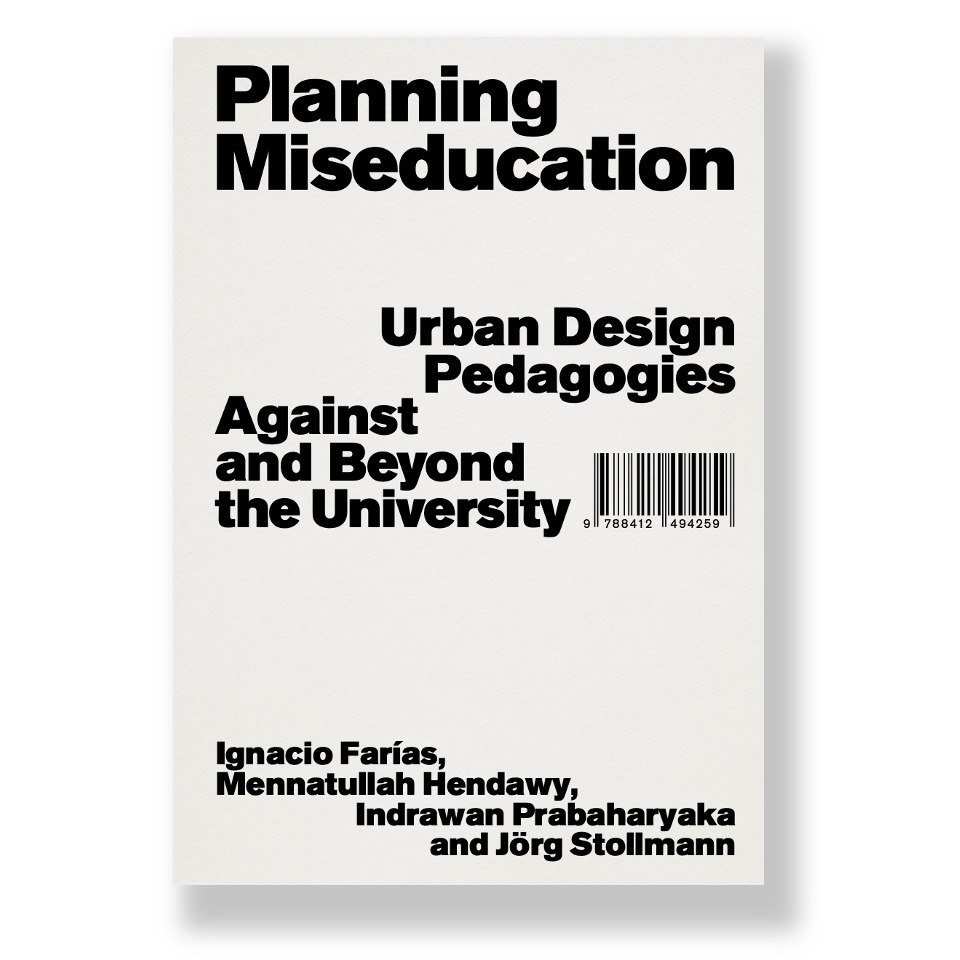
Planning Miseducation is a book full of intentions and intensities. It is an intervention against dissatisfaction with how urban design and planning have been taught. If you ever imagine teaching and learning planning and design for cities differently, rather than mere repetition without making a difference, this book is for you. If you believe that planning and design are about making spaces of hope, for a city yet to come, this book is also for you. It is a reference for those who are keen to stop the bad education, to relearn the urban expertises from informal, street-related knowledges, and to take the risk of planning and organising the positive miseducation of future planners and designers.
Contributors: Geetika Anand, Antonio Bernacchi, Tomás Criado, Rendy Diningrat, Federica Duca, Enrique Espinosa Sánchez, Adolfo Estalella, Ignacio Farías, Verónica Francés, Ester Gisbert, Rupali Gupte, Mennatullah Hendawy, Gilly Karjevsky, José Laulhé, Alicia Lazzaroni, Mark Lemanski, Pablo Llobera, Ana López Ortego, Veljko Markovic, Candela Morado, Enrique Nieto, Manuel Pascual, Alberto Peralta, Camilo Pinto AKA Casi Nadie, Indrawan Prabaharyaka, La Escuela Nunca y los Otros Futuros (Ignacio Rivas, Leandro Cappetto and Eloise Maltby Maland), Poonam Prakash, Nahuel Quiroga, Prasad Shetty, Jörg Stollmann, Fotini Takirdiki, Rosario Talevi, Kemal Taruc, Raúl Urquiaga and Bohdan Volynskyi.
In my contribution I wish to imagine a practice of weird urban study where to miseducate planners to engage in:
A School for the Urban Pluriverse: Learning to Inquire on the Many Ways of Inhabiting
The peculiar Euro-American way of living has come to be premised on highly infrastructured urban landscapes, of variegated kinds. Once considered the pinnacle of modernity, these settlements have had an unmitigated role in unfolding human-centric modes of inhabiting, with disastrous planetary effects: the anthropogenic environmental devastation some call the “urban Anthropocene”. In this disorienting moment, which calls into question how the Moderns have inhabited planet Earth and what they took for granted, might require urban experts and regular urbanites to re-learn what urban habitation might mean from many other urban actors. The current predicaments suggest the need for new learning spaces: not secluded institutions where to be instructed in what must be known; rather, porous sites devoted to making the plural conditions of urban habitability thinkable and liveable as a problem not yet fully known, that is, as a ‘pluriverse’. This notion, cultivated by pragmatist thinkers, has been reinvigorated by a decolonial urban agenda suggesting there are many different and uncommon ways of living beyond the modern ‘one-world world’ worth exploring. Following these lines of insight, this text is a manifesto for A School for the Urban Pluriverse: a space where different urbanites, including urban experts with their technical knowledges, might get acquainted or ‘sensitise’ themselves to the needs of these times of change. Such an experimental pedagogical impulse would demand searching for inspiration in those forms of living — human or other than human — crushed by modern ways of infrastructural inhabitation. Perhaps there are no better guides, no better ways to proceed than to inquire into what it might mean to inhabit together with the many others left behind by the modern urban project. Put otherwise,working with manifold urban actors and thinking collectively about what to do with existing modern infrastructure might invite us to imagine a school where to re-learn what urban inhabiting might mean today.
How to cite: Criado, T.S. (2026). A School for the Urban Pluriverse: Learning to Inquire on the Many Ways of Inhabiting. In I. Farías, M. Hendawy, I. Prabaharyaka & J. Stollmann (Eds.) Planning Miseducation: Urban Design Pedagogies Against and Beyond the University (pp. 271-280) Barcelona: dpr-barcelona | PDF