Categories
ethics ethics, politics and economy of care older people personal autonomy publications sociality & isolation telecare

Older People in a Connected Autonomy? Promises and Challenges in the Technologisation of Care

connected autonomy

New article published in the REIS (Revista Española de Investigaciones Sociológicas), nº 152 October – December 2015, pp. 105-120 published in English & Spanish


Older People in a Connected Autonomy? Promises and Challenges in the Technologisation of Care

(co-authored with Miquel Domènech)

Abstract

This paper offers an ethnographic interpretation of how in a changing context of family care different Spanish home telecare services provide older people with social links to prevent their isolation, granting them ‘connected autonomy’: the promotion of their autonomy and independent living through connectedness. To do so, services need to craft a network of ‘contacts’. Different versions of the term figuration are employed to describe the practical materializations of the forms of relatedness put in place by such services: what roles become available and explicitly supported; what other figurations of relatedness (e.g., kinship, friendship, neighbourliness) they come across; what happens when these different figurations of relatedness meet. In doing this, our aim is to allow space to reflect ethically on the practical relational promises and challenges of these forms of technologized care of older people.

Full text: PDF in English

¿Personas mayores en autonomía conectada? Promesas y retos en la tecnologización del cuidado

(escrito en colaboración con Miquel Domènech)

Resumen 

Este artículo propone una interpretación etnográfica de cómo, en un contexto de cuidado familiar en transición, servicios de teleasistencia españoles buscan proveer a las personas mayores de vínculos sociales para prevenir su aislamiento, articulando una infraestructura de conexión y monitorización para promover lo que denominamos «autonomía conectada». Para funcionar estos servicios necesitan articular redes de «contactos». Empleamos diferentes acepciones del término figuración para entender los significados de la materialización práctica de diferentes formas relacionales por parte de estos servicios, prestando atención a: los roles que hacen disponibles; con qué otras figuraciones relacionales se encuentran y qué ocurre al encontrarse. A partir de esta descripción, abrimos un debate ético acerca de las promesas y retos relacionales que enfrentan los intentos por tecnologizar el cuidado de las personas mayores.

Texto completo: PDF en castellano

Categories
caring infrastructures ethics, politics and economy of care installation maintenance and repair objects of care and care practices older people politics and economy of care publications techniques & ways of doing telecare

Analysing hands-on-tech carework in telecare installations: Frictional Encounters with Gerontechnological Designs

PrendergastAging

Chapter recently published in the book AGING AND THE DIGITAL LIFE COURSE, edited by David Prendergast and Chiara Garattini, Volume 3 of Berghahn’s Life Course, Culture and Aging: Global Transformations Series [ISBN  978-1-78238-691-9 (June 2015)]

Analysing hands-on-tech carework in telecare installations: Frictional Encounters with Gerontechnological Designs

(Co-written with Daniel López)

Brief summary 

In the past twenty years gerontechnological technologies have been marketed as plug-and-play solutions to complex and costly care necessities. They are expected to reduce the cost of traditional forms of hands-oncare. Science and Technology Studies (STS) have contributed to discussing this idea (for an overall perspective, see Schillmeier and Domenech 2010) by pointing at important transformations in the care arrangements where these technologies are implemented. Instead of just ‘plug-and-play’ solutions, transformations are found in protagonists, their roles and functions, and more importantly in redefining care. This chapter seeks to add new nuances to the definition of care in these scenarios by paying attention to what we term ‘hands-on-tech care work’. This terminology refers to the practices, usually undertaken by technicians (installation, repair and maintenance), which hold together the silent infrastructures that are now considered to be suitable and sustainable forms of care work for ageing societies. Hands-on-tech care work is usually hidden from most of the discussions concerning new care technologies for older people. On the one hand this is because installation, repair and maintenance work on telecare devices is considered as a mere technical procedure, i.e. not considered to be part of care work. On the other hand it is because of the widespread view that if technologies are well designed, installing them is simply a matter of ‘plug-and-play’. However, if we look carefully into the installation process, these concepts are easily refuted. This is because these technologies need to be continually welcomed, tuned, adjusted, tweaked, personalized, updated and installed.

Full text: PDF

Categories
ethics, politics and economy of care functional diversity & disability rights independent-living legal objects of care and care practices older people open sourcing personal autonomy techniques & ways of doing urban and personal devices valuation

The Radicalisation of Care: Practices, Politics & Infrastructures | 19 & 20 NOV 2014, Barcelona

Radicalisation of care

Daniel López, Israel Rodríguez Giralt and I have the honour of hosting the workshop “The radicalisation of care: Practices, Politics and Infrastructures” | #radicare
19 & 20 November 2014 | Barcelona, Open University of Catalonia

Categories
caring infrastructures ethics, politics and economy of care gendered division of labour installation legal maintenance and repair older people personal autonomy publications telecare valuation

Installing Telecare, Installing Users: Felicity Conditions for the Instauration of Usership

Installations

New collective article published in Science, Technology & Human Values, 39(5): 694-719!!

Installing Telecare, Installing Users: Felicity Conditions for the Instauration of Usership

 (co-written with Daniel López, Celia Roberts & Miquel Domènech)

Abstract:
This article reports on ethnographic research into the practical and ethical consequences of the implementation and use of telecare devices for older people living at home in Spain and the United Kingdom. Telecare services are said to allow the maintenance of their users’ autonomy through connectedness, relieving the isolation from which many older people suffer amid rising demands for care. However, engaging with Science and Technology Studies (STS) literature on “user configuration” and implementation processes, we argue here that neither services nor users preexist the installation of the service: they are better described as produced along with it. Moving beyond design and appropriation practices, our contribution stresses the importance of installations as specific moments where such emplacements take place. Using Etienne Souriau’s concept of instauration, we describe the ways in which, through installation work, telecare services “bring into existence” their very infrastructure of usership. Hence, both services and telecare users are effects of fulfilling the “felicity conditions” (technical, relational, and contractual) of an achieved installation.

Keywords: Telecare, older people, installation, configured user, felicity conditions, instauration, Souriau

Acknowledgements

First of all, we would like to thank Nizaiá Cassián for the collaborative work that led to the idea of this paper. Secondly, the research shown here is part of the project “Ethical Frameworks for Telecare Technologies for older people at home” (EFORTT, funded by the European Commission’s FP7 SiS programme, project no. 217787). We would like to thank Maggie Mort as coordinator of the project as well as the research teams for discussions. Thirdly, our acknowledgment goes to the different telecare services and users that took part in our studies, without whose support none of this could have been possible. Last but not least, the authors would also like to thank the two anonymous reviewers for their helpful comments in the development of this paper.

Full text: PDF

Pre-print
[scribd id=199585771 key=key-8fpil1idgizi4trn5bu mode=scroll]

Categories
caring infrastructures ethics, politics and economy of care legal objects of care and care practices older people personal autonomy publications security & location sociality & isolation telecare

¿Cómo se mantiene una usuaria? Prácticas de apuntalamiento en la teleasistencia para personas mayores

F. J. Tirado & D. López (Eds.), Teoría del actor-red: más allá de los estudios de ciencia y tecnología. Barcelona: Amentia.

Por fin, después de una larga espera se publica el libro Teoría del actor-red: más allá de los estudios de ciencia y tecnología que presentamos en el II Encuentro de la Red de Estudios Sociales de la Ciencia y la Tecnología de Gijón, que editan Francisco Tirado y Daniel López y que publica la editorial Amentia. Gracias a ambos por las labores de gestión a la hora de compilar este libro, con un montón de contribuciones interesantes, lo que auguran que quizá se convierta en un, como alguna vez lo ha llamado Isaac Marrero,  futuro “clásico underground”. También gracias a la editorial por atreverse a seguir sacando proyectos tan interesantes en estos tiempos económicamente inciertos. Aunque en breve estará disponible para su venta online, os dejo por aquí como aperitivo toda la información. Si todo va bien, estará disponible en el próximo III encuentro de la Red de Estudios Sociales de la Ciencia y la Tecnología en Barcelona. ¡Qué ganas de tener un ejemplar físico entre mis manos! Dejo por aquí un enlace a mi capítulo…

¿Cómo se mantiene una usuaria? Prácticas de apuntalamiento en la teleasistencia para personas mayores

PDF 

[scribd id=147404331 key=key-27ig118b7bgj9k9bzbky mode=scroll]

INFORMACIÓN SOBRE EL LIBRO

F. J. Tirado & D. López (Eds.). (2012). Teoría del actor-red: más allá de los estudios de ciencia y tecnología. Barcelona: Amentia | ISBN: 978-84-938318-8-2

Índice

Teoría del actor-red: un pragmatismo contemporáneo | Daniel López Gómez y Francisco J. Tirado: 1

La nueva materialidad del cáncer. Teoría del actor-red y objetos potenciales | Jorge Castillo Sepúlveda y Francisco Tirado:  17

Software Libre: Abriendo las cajas negras de la tecnociencia | Blanca Callén Moreu:  71

¿Cómo se mantiene una usuaria? Prácticas de apuntalamiento en la teleasistencia para personas mayores | Tomás Sánchez Criado: 111

Transiciones hacia otra(s) teoría(s) del actor-red: agnosticismo, interés y cuidado | Daniel López Gómez: 157

El rol diplomático del científico social y el modelo de normatividad interpretativa de Bruno Latour | Paloma García Díaz: 187

Aportes y límites de la cosmopolítica en la Teoría del Actor-Red | Yann Bona Beauvois y Salvador Iván Rodríguez Preciado: 217

Habitando espacios socionaturales: reflexiones desde la ecología política | Ignacio Mendiola: 243

Jamás hemos sido ingenuos (dóciles sí, pero ingenuos jamás): un estudio sobre la constitución del sujeto ingenuo en los laboratorios psicológicos | Arthur Arruda Leal Ferreira: 283

La diferenciación de los colectivos: ensamblajes, comunicaciones y simetría total | Ignacio Farías: 301

Por una teoría del actor-red menor: perspectivismo y monadología | Isaac Marrero-Guillamón: 331

De redes y otros enredos: acerca de la ontología política de la red |Israel Rodríguez-Giralt: 357


Categories
caring infrastructures ethics, politics and economy of care events objects of care and care practices older people participatory & collaborative design of care infrastructures

Conferència Ciutadana de la Gent Gran de Barcelona | GESCIT (UAB)

“El Grup d’Estudis Socials de la Ciència i la Tecnologia (GESCIT) de la Universitat Autònoma de Barcelona està preparant una conferència ciutadana de la gent gran de Barcelona per tractar els processos de digitalització de la societat. El propòsit d’aquest esdeveniment és obrir la participació ciutadana al debat sobre el nostre futur digital.

A les societats actuals, els telèfons mòbils, internet, els ordinadors, les tabletes, les xarxes socials, han portat a un accelerat procés de digitalització. En els darrers anys, diferents països i entitats supranacionals han tractat d’endegar aquest procés a través de diferents iniciatives com ara plans estratègics, agendes o polítiques públiques específiques.

Amb l’objectiu d’obrir al debat públic a aquest procés de digitalització, el GESCIT-UAB organitzarà una trobada de gent gran en la que es debatran les qüestions que se’n deriven (polítiques adients, controvèrsies públiques, necessitats específiques, discriminació de certs col.lectius…) per tal d’elaborar propostes d’intervenció. Seguint l’exemple d’experiències similars dutes a terme a nivell internacional, la trobada tindrà el format d’una conferència ciutadana.

Les conferències ciutadanes faciliten la interacció entre especialistes de diferents disciplines i la ciutadania no experta per tal de discutir sobre temes amb un cert grau de complexitat científico-tècnica. Un element distintiu de la conferència organitzada pel GESCIT serà que promocionarà la participació activa de la gent gran. La finalitat és lliurar a l’Ajuntament de Barcelona un document amb la visió que la gent gran té de la digitalització de la societat i les recomanacions que considerin pertinents”

Què és una Conferència Ciutadana? | Gent Gran i Digitalització de la Societat.

 
Categories
ethics, politics and economy of care objects of care and care practices older people personal autonomy press releases publications sociality & isolation

Declaración de Barcelona sobre Envejecimiento Activo en casa

Interesante iniciativa

Categories
ethics, politics and economy of care independent-living older people participatory & collaborative design of care infrastructures personal autonomy policies press releases sociality & isolation valuation

¿El envejecimiento activo como envejecimiento activista?

Hace un tiempo que vengo dándole vueltas a una idea, desde que empezó a hablarse del movimiento de los iaioflautas: ¿cómo afectaría a las tesis del “envejecimiento activo” pensar desde este formato de activismo de las personas mayores?

El “envejecimiento activo” es un conjunto de términos y prácticas (bastante menos orgánicos de lo que se cree) que se suele plantear como nuevo marco de actuación gerontológica que huya de las caracerizaciones “pasivas” de la vejez. En muchas ocasiones el término es ocupado por versiones de la gerontología de orientación psicológica (véase la obra de R. Fernández-Ballesteros) y su modelo bio-psico-social (que básicamente plantea algo así como que los seres humanos estamos cortados por tres estratos, con tres tipos de disciplinas que pueden gobernar cómo cada uno de estos estratos puede ser mejor utilizado o empleado para tener una vida “con calidad”, “saludable” y “exitosa”). Las críticas de algunos de los deniminados “critical gerontologists”, como Stephen Katz es que normalmente esto se plantea como un bien en sí mismo, al margen de cualquier contexto singular y político particular.

Pienso en si estas nuevas formas del “poder gris“, como algunas personas le llaman (véanse los Cuadernos de la FIAPA sobre el tema: vol. 1 y vol. 2), pudiera estar transformando desde dentro las idaes y prácticas de tipo individual-liberal sobre la mayor implicación de los mayores en sus entornos –que muchas veces se plantea desde la idea de recuperar a los “seniors”, profesionales bien formados, para la toma de decisiones, manteniéndoles en condiciones de productividad e incorporando su sabiduría para los contextos productivos actuales, como en el caso del movimiento SECOT– a partir de un formato de participación activista, al modo de lo que hicieron los “Grey panthers” americanos.

¿Cómo un formato de participación como este re-haría o transformaría el propio significado del término así como de los significados y efectos de las actividades en las que toman parte los mayores (normalmente gobernadas por profesionales que ponen a los mayores a hacer cosas en diferentes entornos: jugar, bailar, etc.)?

—

Todo esto por haber leído esta noticia del Washington Post:

“They occupy banks, stage sit-ins at government buildings and roar their rage at their own government and at German Chancellor Angela Merkel.

They also use canes and crutches to get to these so-called ‘actions’ — because their average age is 70.

These Spanish grannies and grandpas, part of a protest movement for seniors called the ‘yayoflautas,’ say you are never too old for a revolution. The change they want is for Spain to slow down its tough budget cuts pushed by Germany and instead focus on growth and job creation to solve their country’s crippling debt crisis

[…]

The group was formed after about 15 grandmothers and grandfathers sharing a meal at a Chinese restaurant in Barcelona decided they needed to do something because they thought the younger generation was too passive about the situation in Spain. Since its founding, the group has grown to more than 1,000 members.

[…]

‘Becoming a yayoflauta is more helpful than going to the doctor,’ Mr. Gonzalez said.

‘You are mentally active. You do exercise because you go here and there. You have less time to think about your ailments. You are not lonely anymore, and you have fun.'”

Read more: In Spain, they’re never too old for a revolution – Washington Times http://www.washingtontimes.com/news/2012/nov/8/in-spain-theyre-never-too-old-for-a-revolution-sen/?page=3#ixzz2BpQX3Bzo
Follow us: @washtimes on Twitter
Categories
caring infrastructures ethics, politics and economy of care falls & accidents gendered division of labour independent-living legal objects of care and care practices older people personal autonomy policies publications security & location sociality & isolation telecare valuation

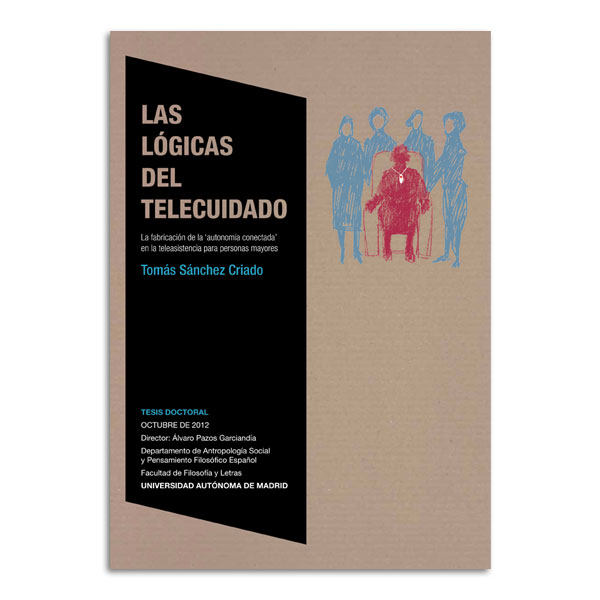
Las lógicas del telecuidado: La fabricación de la ‘autonomía conectada’ en la teleasistencia para personas mayores | Tesis doctoral

Las lógicas del telecuidado: La fabricación de la ‘autonomía conectada’ en la teleasistencia para personas mayores | Tomás Sánchez Criado

Tesis doctoral presentada en Octubre de 2012 en el marco del POP de Antropología de Orientación Pública de la Universidad Autónoma de Madrid

Categories
domotics & AAL ethics, politics and economy of care independent-living materials older people participatory & collaborative design of care infrastructures personal autonomy press releases resources sociality & isolation valuation

Jubilares: envejecimiento participativo y auto-gestionado

Gracias a un post del blog “Innovation for growth”, escrito por el experto en co-creación Carlos Bezos, acabo de descubrir “Jubilares” una interesante experiencia de “envejecimiento activo mediante el diseño, construcción y autogestión de la propia comunidad de mayores“