Gracias a Noelia Ramírez y Begoña Gómez por el buen rato departiendo sobre la importancia de las sombras y nuestro ficticio Departamento de Umbrología en Amiga date cuenta de Radio Primavera Sound, parte de un programa fascinante sobre las Estéticas del calor, llenas de referencias interesantes (como el texto Sudor de Mariela Sancari, que me llevé apuntado para mis lecturas veraniegas).
Achicharradas, sofocadas, torrefactas encaramos el penúltimo ADC de la temporada. Por si no lo habíais notado, el calor ya no es calor, es el síntoma de que hemos entrado en el Termoceno, como nos explica el listísimo Tomás Criado. Hablamos de noches tórridas, de casas de verano, de películas sudorosas, y declaramos (perdón) inaugurado el Dead Girl Summer: el verano de la muerta en vida.
Aquí os dejo el programa en vídeo (me tenéis hablando desde el minuto 1:11:56 y el 1:39:00)
The whole seminar was also recorded, and here’s the video of my talk:
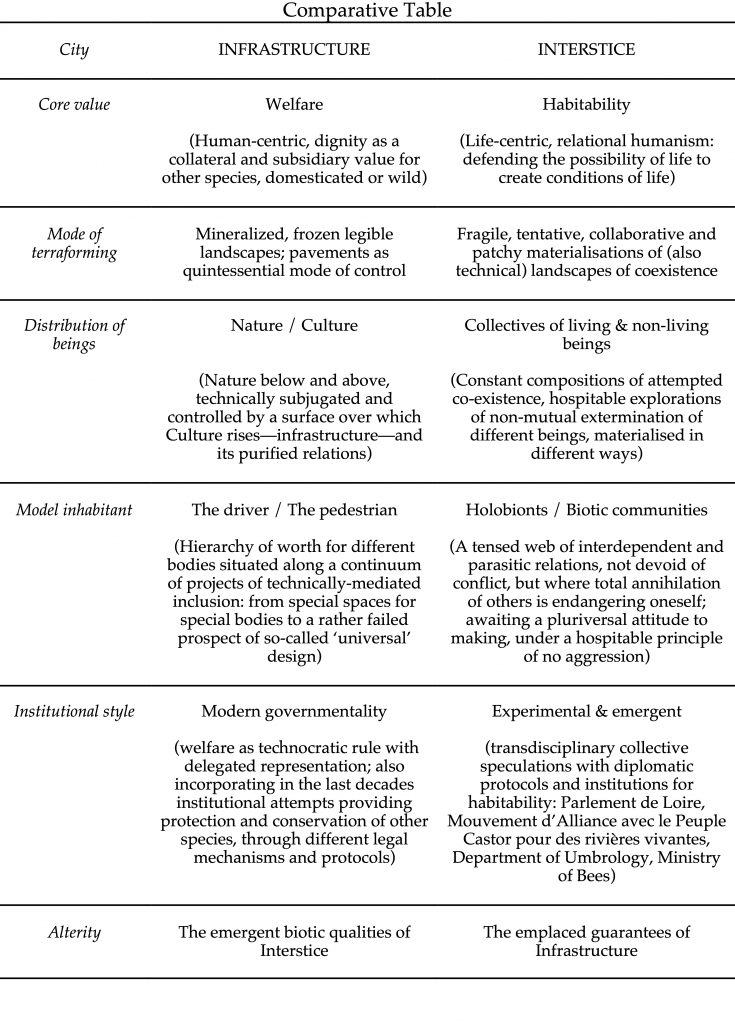
The possible city: On dismantling Infrastructure to make Interstice habitable for all life forms
Although the genealogy of the term ‘public space’ is relatively recent, its material form has deeper roots and can be read as part of what could be called a modern Euro-American mode of building cities. Drawing from Egin Isin’s work public space can be read as part of a genealogy of the city as a ‘machine of difference,’ laying out distinct figures of citizenship, founded on an analysis of their alterities. Here, I offer an update to Isin’s typology in the form of a ‘tale of two cities,’ one attempting to make it face the conditions of our urban present. The first I will call Infrastructure, the existent city at the end of the modern world: one that divides, spatializes, and segregates bodies and beings according to notions of hygiene and modernist governmentality. I exemplify through the historical treatment of pavements, rats, dogs and trees, as well as disabled people. I argue that this form of urban infrastructuration offers nothing more than a ‘conditional inclusion’ to humancentric welfare. The focus on devising infrastructural solutions (hard surfaces or similar brutal forms of urban emplacement) has contributed to new forms of othering, exposing a wide plurality of urban bodies to uninhabitable milieus, further eroding the welcoming and gathering functions of public space. The second city it’s called Interstice: the possible city yet to come, sadly visible because of as well as subjugated by Infrastructure. Intervening in this domain of infrastructural solutionism, I foreground activist, artistic and pedagogical projects where multispecies urban landscapes appear less as an infrastructure and more as interstices of urban habitability: where different forms of coexistence between human and non-human bodies can be explored and supported.
How to cite: Criado, T. (29 April 2026). The possible city: On dismantling Infrastructure to make Interstice habitable for all life form International seminar Interspecies City, CCCB, Barcelona. https://hdl.handle.net/10609/155182
Por la intermediación de los comisarios web de La Casa de la Arquitectura––Bartlebooth (Antonio Giráldez López y Pablo Ibáñez Ferrera) y Diego Morera Sánchez, a quienes agradecemos su atención y amabilidad––hace unos meses tuvimos el enorme privilegio de poder presentar nuestro trabajo en el Departamento de Umbrología en una conversación que acaba de ver la luz.
En la misma participamos: Tomás Criado (CareNet, UOC), Marc Sureda (Arquitectura de Contacte) y Antonio R. Montesinos (Laboratorio de Pensamiento Lúdico).
En ella presentamos el Departamento de Umbrología, una institución ficticia de estudio e intervención sobre la vida urbana de las sombras, cuyo principal objetivo es revitalizar los saberes y prácticas de las sombras para la habitabilidad de las ciudades en contextos de crisis climática.
Trabajando «en las sombras, sobre la sombra», el Departamento de Umbrología es un proyecto transdisciplinar financiado por la Fundación Daniel y Nina Carasso que articula a cuatro socios de la ciudad de Barcelona en la encrucijada de las humanidades, la arquitectura, las artes y las ciencias ambientales: los grupos CareNet y DARTS de la UOC, el colectivo Arquitectura de Contacte, las ambientólogas y divulgadoras científicas de Nusos Coop y los artistas especulativos del Laboratorio de Pensamiento Lúdico.
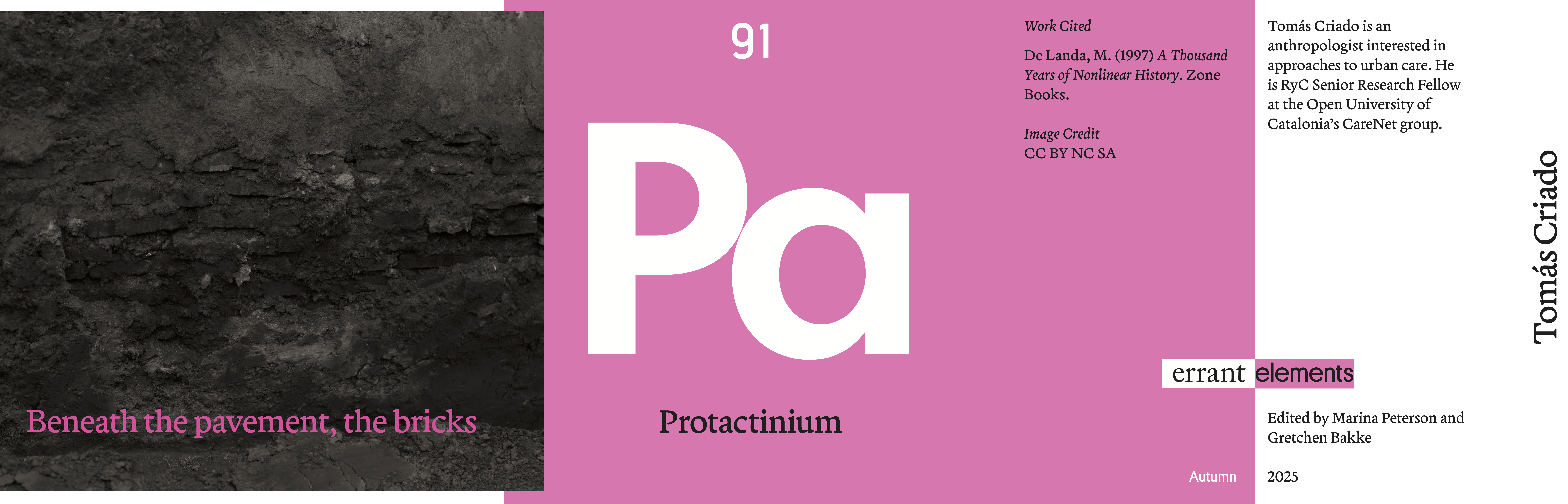
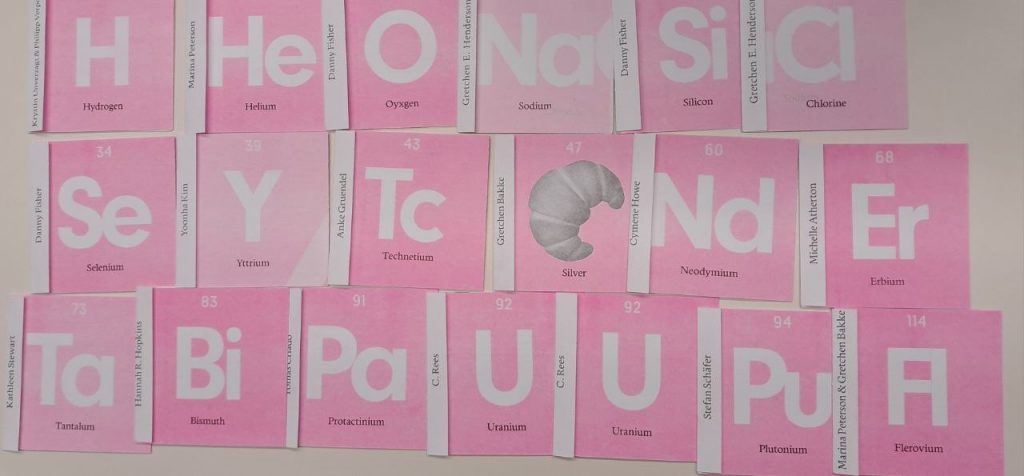
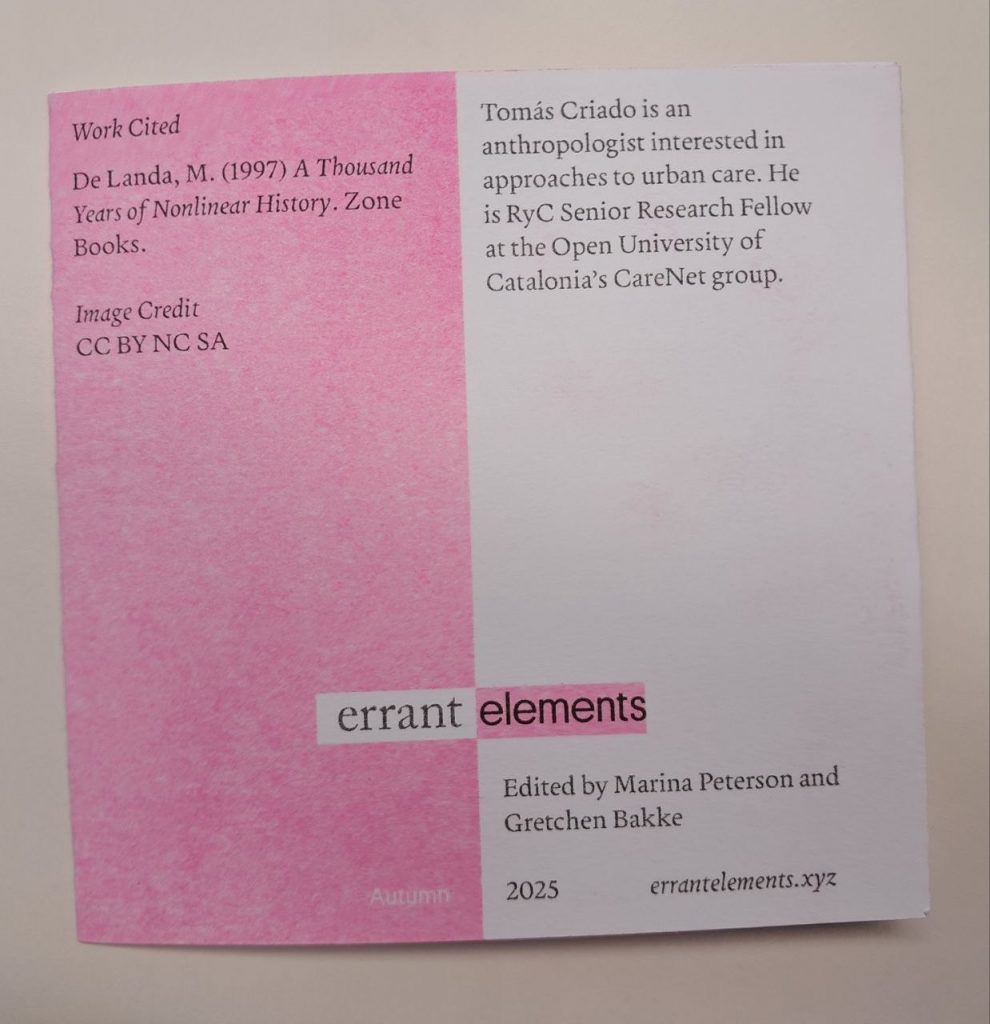
For the last couple of years Marina Peterson and Gretchen Bakke have been putting together Errant Elements, a beautiful project to create a chapbook series organized around the Periodic Table of the Elements.
In their words:
Dmitri Mendeleev left gaps in his model of the periodic table for the not-yet-known — elements that the prior century sought to standardize and classify by atomic weight and chemical properties — to allow history to fill in, but not to leave open to speculation, or to leave alone. What can be made from what is that isn’t yet? How might the elements be constitutive of something different? What is missing or lacking? How can those absences be incorporated or invented into the base materials? What needs to change from what we have to make what we don’t have?
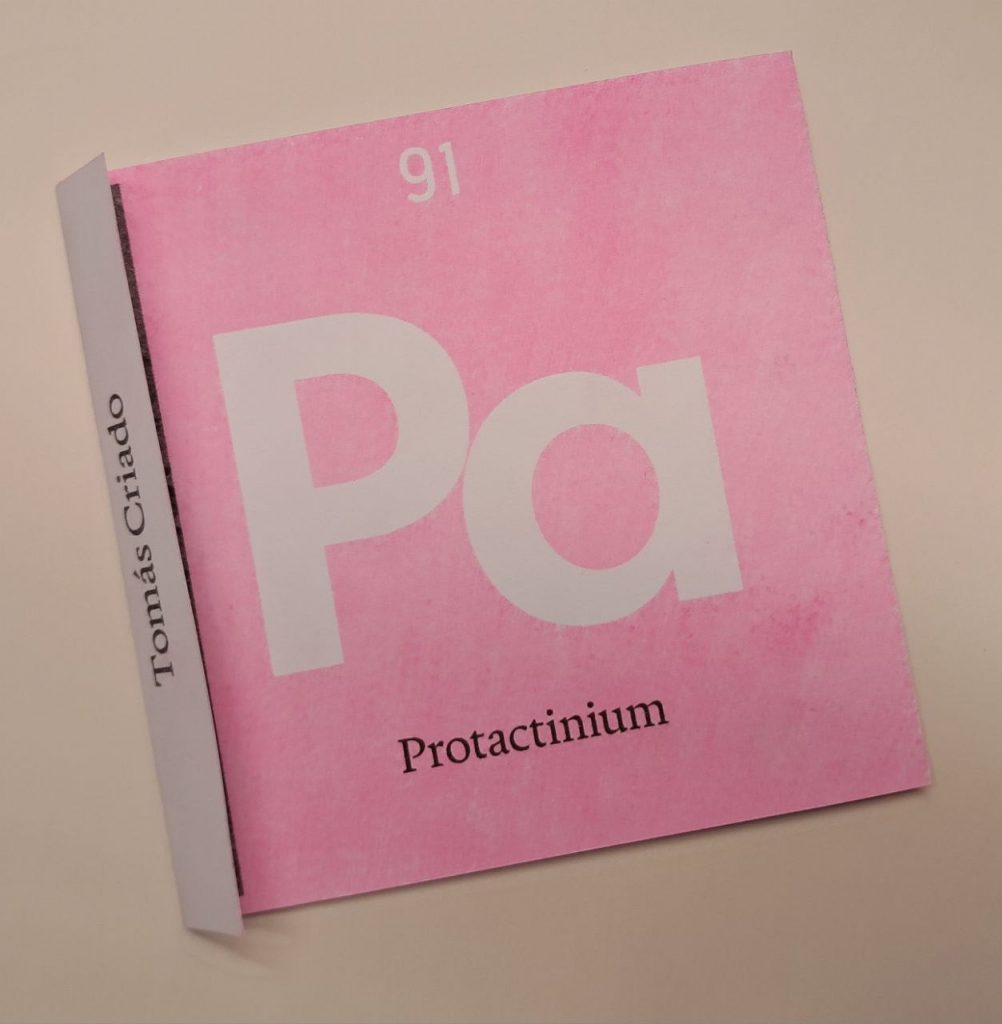
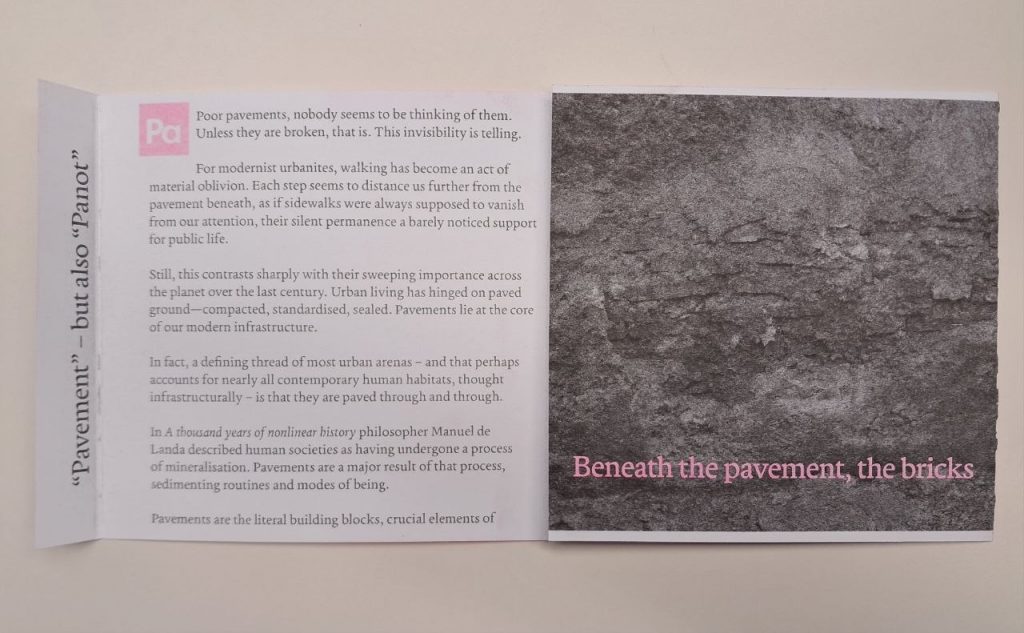
The form – 118 folded chapbooks designed to be combined in various ways – supports a collective exploration of the combinatory affordances and stories of the elements. The format is a trifold brochure that folds into a 5×5” square. This allows readers to connect pieces in different ways, constructing official or imagined elements and reading across diverse entries in ways that open new imaginaries.
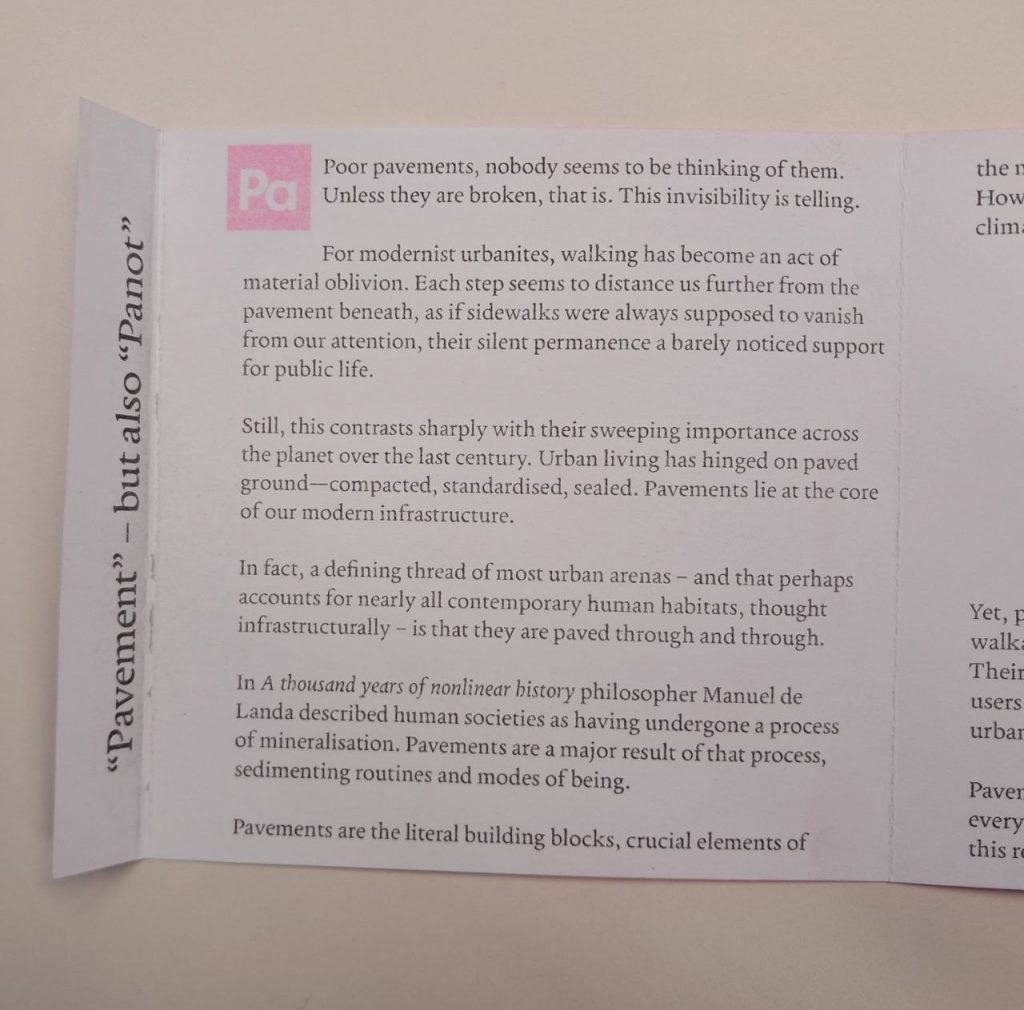
Thanks to their gracious invitation, I took the chance to propose a submission on the element Pa (Protractinium) or, rather, in my attempt: “Pavements” – but also “Panot”, something of a particular obsession of mine since I started doing fieldwork on urban accessibility.
My errant element starts like this:
Poor pavements, nobody seems to be thinking of them. Unless they are broken, that is. This invisibility is telling
…
You could check it out below. But, FYI, the whole set of chapbooks will be for sale. Contact the editors for more info!
How to quote: Criado, T.S. (2025.) Pa – “Pavement” but also “Panot”. In M. Peterson & G. Bakke (Eds.) Errant Elements, issue 2: 91. | PDF