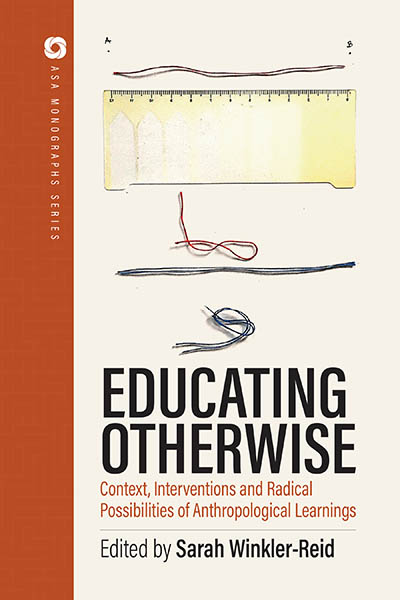
As part our contributions to the ASA2022: Anthropology Educates online conference (14 March to 7 November 2022), with my long-time colleagues Ester Gisbert and Enrique Nieto, we wrote a chapter contribution on our anthropological explorations of architectural education.
Learning and education are fundamental to human experience – yet they have often been side-lined in anthropological inquiry. Educating Otherwise brings these questions to the centre, exploring what anthropology can reveal about how people learn, and what learning reveals about anthropology itself. Spanning formats ranging from short essays to ethnographic fiction, the volume is organised around five themes: anthropology as education, decolonising the academy?, student-academic collaborations, anthropology and the university, and anthropology across disciplines. Together, these examine how anthropological education can perpetuate exclusion and privilege while also offering vivid, grounded accounts of more regenerative ways of teaching and learning.
Here is our contribution:
Mutual Intraventions: Anthropology and/as Architecture, and the Other Way Round
In recent years, both independently and in a series of teaching collaborations, we have been exploring what architecture and anthropology can learn from one another. Whereas for anthropologists, architecture could inspire a more materially grounded, compositionist, and interventionist approach, anthropology’s emphasis on processual and relational inquiry, together with the conceptual vocabularies and borrowings from more-than-human, multispecies and new materialist thought, might also help us to rethink architectural practice. In this chapter we wish to discuss the ‘conceptual travails’ – or, as we will call them, the ‘mutual intraventions’ – we have been undertaking over the last eight years.
The climatic mutation of extreme heat has plunged modern cities into their greatest design crisis in centuries. This mutation challenges our cultural conceptions of urban habitability and demands a profound shift in our conceptual and political institutions. What is the role of the humanities in this context? My recent ethnographic work seeks to reverse the technocratic trend of seeking quick techno-fixes. In an era of urgency, how can we prioritize collective thinking, when reflection is often dismissed as a hindrance to decision-making? How can we shape future urban spaces without imposing a singular vision, accounting instead for the multiplicity of human and non-human life?
As I see it, we must reclaim experimentation and ways of ‘probing in the dark’ to reimagine future habitability. One such space is the Department of Umbrology, a speculative institution for the study of and intervention in the urban life in the shades. This project unites Barcelona-based partners across humanities, architecture, arts, and environmental sciences: the CareNet and DARTS groups (UOC), Arquitectura de Contacte, Nusos Coop, and the Laboratori de Pensament Lúdic. Beginning in January 2026, through a series of seminars, multimodal workshops and a festival the project collectively wishes to work out ‘darkness’ of the present: highlighting intergenerational and interspecies knowledge to reclaim the popular sovereignty of shades and the protection they offer in a changing climate.
Speaker
Tomás Criado is an anthropologist and STS scholar, especially interested in urban environmental phenomena. He works as a Ramón y Cajal Senior Research Fellow at the CareNet group of the Social and Cultural Transformations Interdisciplinary Research Centre (TRÀNSIC) at the Open University of Catalonia. In his ethnographic and public engagement work, he has inquired on different forms of material and knowledge politics in environments where care is invoked as a mode of urban intervention: either as a peculiar form of techno-scientific activism (democratising knowledge, design practices and infrastructures) or as a practice of articulating peculiar ecologies of support (accessible and late life urbanism, urban heat mitigation plans, multispecies architecture).
Chair/discussant:Dr Angela Marques Filipe (Sociology, Durham University). Email: angela.m.filipe@durham.ac.uk.
The Zoom link will be circulated closer to the event. If you have any access requirements, please get in touch with us at imh.events@durham.ac.uk.
En mi viaje a Ciudad de México el pasado mes de agosto, mi querido amigo Pablo Hoyos (profesor de psicología social en la UAM-Itzapalapa) me invitó a participar del proyecto de podcast Puentes voladizos columpiándose: un fascinante proceso de invención colaborativa (explorando formas de ex-carcelar el relato) entre las Mazmorras, un grupo de mujeres privadas de la libertad en el CERESO de Escobedo (Nuevo León, México), y diversxs aliades con quienes han venido jugando a problematizar temas contemporáneos tendiendo puentes desde la cárcel.
Podcast: Puentes voladizos columpiándose
Esta primera temporada, las Mazmorras piensan y debrayan junto al Departamento de Umbrología, encabezado por Tomás Criado de la Universitat Oberta de Catalunya (UOC).
Las Mazmorras son: Érika, Isabel, Mayte, Queta, Leti, Marisela, Casandra, Ana Laura.
The public in public spaces is usually understood as consisting of human beings (and perhaps their pets). But the public can include many more life forms. There is a vast variety of organisms, from microbes and fungi to plants and animals whose home is the city.
What would it mean to design for all those publics? How can we take into account the lives of all those urban dwellers who are not human, and who are not always treated with due compassion? What is a public space that might be accessible for all forms of life?
9:30 a.m. Introduction: Hans Ibelings
9:45 – 11:45 a.m.
The evolution of public space
Urban public space has a very long history, but the term “public space” is only half a century old, and its definition has been evolving and expanding.
Sonia Curnier, architect and associate professor in Architectural and Urban Theory / HEIA-FR Tomás Criado, anthropologist and interdisciplinary researcher at the Universitat Oberta de Catalunya
12:00 – 1:30 p.m.
Life in the city
How can we imagine city life in an all-encompassing way? What does it mean to be human in a public space for everyone? How can we encounter and engage with other organisms?
Michael Marder, philosopher, Ikerbasque Research Professor of Philosophy at the University of the Basque Country Marta Tafalla, philosopher and lecturer at the Autonomous University of Barcelona
3:00 – 5:00 p.m.
The design of public space for other than humans
How can and should public space accommodate organisms that are other than human? What would this require from designers if public space is to be made truly inclusive?
Helen Wilson, social and cultural geographer, professor at Durham University Aura Luz Melis, architect and partner at the Amsterdam-based design studio Inside Outside Joan Pino Vilalta, professor of Ecology at the Autonomous University of Barcelona and director of the Centre for Ecological Research and Forestry Applications (CREAF)
Por la intermediación de los comisarios web de La Casa de la Arquitectura––Bartlebooth (Antonio Giráldez López y Pablo Ibáñez Ferrera) y Diego Morera Sánchez, a quienes agradecemos su atención y amabilidad––hace unos meses tuvimos el enorme privilegio de poder presentar nuestro trabajo en el Departamento de Umbrología en una conversación que acaba de ver la luz.
En la misma participamos: Tomás Criado (CareNet, UOC), Marc Sureda (Arquitectura de Contacte) y Antonio R. Montesinos (Laboratorio de Pensamiento Lúdico).
En ella presentamos el Departamento de Umbrología, una institución ficticia de estudio e intervención sobre la vida urbana de las sombras, cuyo principal objetivo es revitalizar los saberes y prácticas de las sombras para la habitabilidad de las ciudades en contextos de crisis climática.
Trabajando «en las sombras, sobre la sombra», el Departamento de Umbrología es un proyecto transdisciplinar financiado por la Fundación Daniel y Nina Carasso que articula a cuatro socios de la ciudad de Barcelona en la encrucijada de las humanidades, la arquitectura, las artes y las ciencias ambientales: los grupos CareNet y DARTS de la UOC, el colectivo Arquitectura de Contacte, las ambientólogas y divulgadoras científicas de Nusos Coop y los artistas especulativos del Laboratorio de Pensamiento Lúdico.
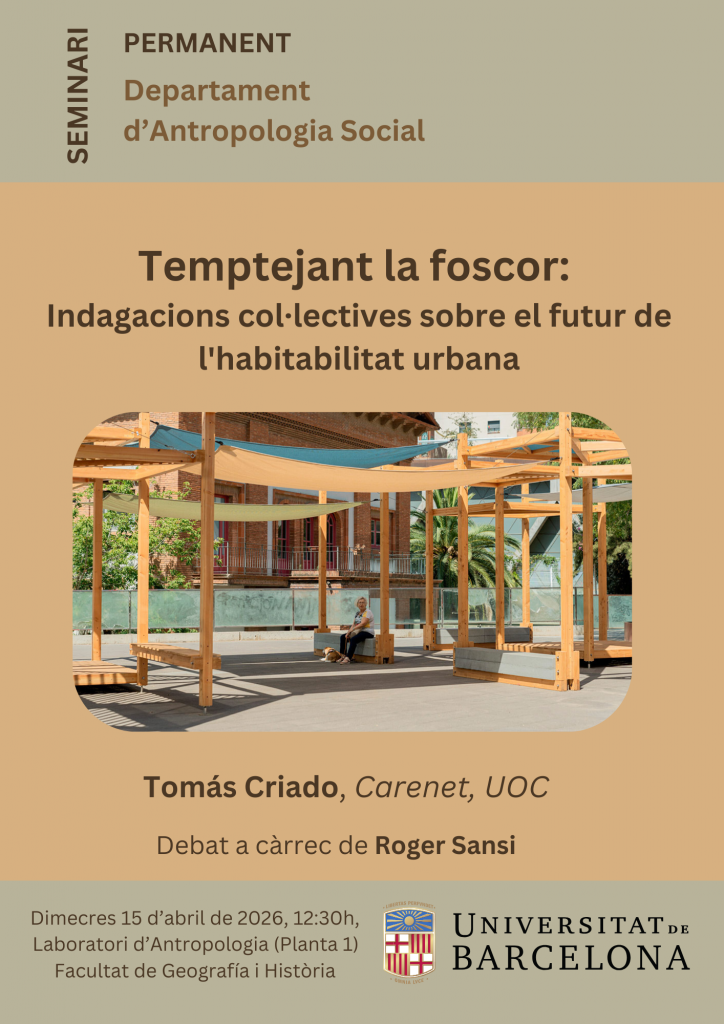
El proper dimecres 15 d’abril a les 12:30 presentaré al Seminari permanent del Departament d’Antropologia Social de la UB, en debat amb Roger Sansi (UB).
On: Laboratori d’Antropologia (Planta 1) Facultat de Geografia i Història, UB.
Activitat oberta fins a completar aforament
Temptejant la foscor: Indagacions col·lectives sobre el futur de l’habitabilitat urbana
La calor extrema i altres mutacions climàtiques actuals han abocat les ciutats del present a la major crisi de disseny a la qual s’han enfrontat en els últims segles. Aquesta transformació i els graus efectes de desigualtat que comporta, desafien radicalment les nostres concepcions culturals de l’habitabilitat urbana i exigeixen una transformació profunda de les nostres institucions conceptuals i polítiques. Quin hauria de ser el paper de les humanitats en aquest context? El meu treball recent s’ha centrat a revertir la tendència comuna en aquest context urbanístic a buscar solucions ràpides per part de professionals molt ben preparats, però amb pràctiques profundament tecnocràtiques. Això planteja una qüestió crucial en un context d’urgència: Com podem prendre’s seriosament la necessitat d’un pensament col·lectiu sobre els efectes de la mutació climàtica en curs, en un context de rapidesa on pensar es fa equivaler a ralentir els processos de presa de decisions? Com podem abordar i afectar la configuració futura de l’espai urbà sense imposar una única visió, i considerant la multiplicitat de formes de vida (humanes i no humanes) que hi coexisteixen? En un context com aquest, necessitem reivindicar la rellevància de l’experimentació i els temptejos amb tot el que no sabem, generant espais d’indagacions col·lectives per tal d’obrir la pregunta de què podria esdevenir l’habitabilitat urbana del futur. Un d’aquests espais possibles és el “Departament d’Umbrologia”, una institució especulativa per a l’estudi i la intervenció de la vida urbana de les ombres. Aquest projecte articula quatre socis de la ciutat de Barcelona a la cruïlla de les humanitats, l’arquitectura, les arts i les ciències ambientals: els grups CareNet i DARTS de la Universitat Oberta de Catalunya, el col·lectiu Arquitectura de Contacte, les ambientòlogues i divulgadores científiques de Nusos Coop i els artistes especulatius del Laboratori de Pensament Lúdic. El projecte es desenvoluparà a partir del gener de 2026 a través d’una sèrie de tallers col·laboratius de co-creació on temptejarem col·lectivament la foscor del moment present. Es tancarà al 2027 amb un Festival de les Ombres on mirarem de donar la rellevància present i futura a molts sabers intergeneracionals, interculturals i interespècie que ens ajudin a reclamar la sobirania popular de les ombres i la protecció que aquestes fan possible en temps de mutació climàtica.
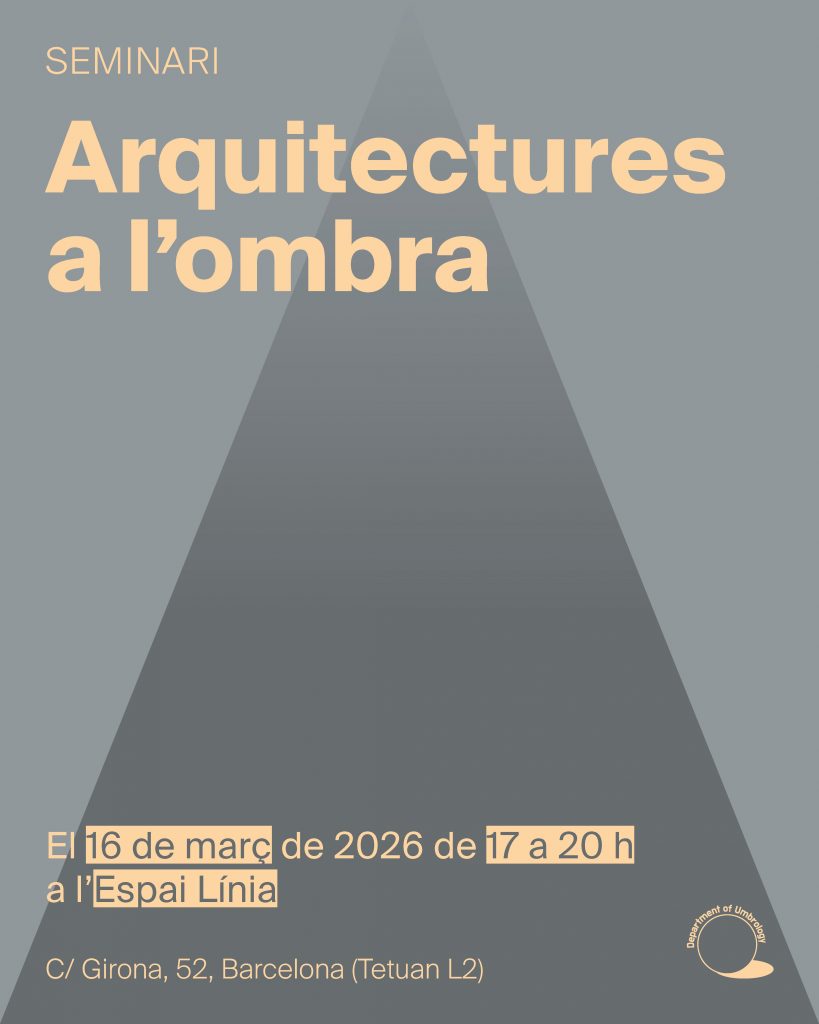
Us convidem al seminari del Departament d’Umbrologia Arquitectures a l’ombra que tindrà lloc el proper 16 de març 2026 entre les 17:00 i les 20:00, a l’Espai Línea (c. de Girona, 52, 08009 Barcelona – proper a L2 Tetuan), organitzat pel Departament d’Umbrologia i coordinat per Arquitectura de Contacte SCCL
– Oriol Roig, dissenyador industrial i paisatgista
Amb aquestes persones convidades ens preguntem:
Com habitem l’ombra? Quins són els seus impactes en la nostra salut? Com l’hem de dissenyar? Quines comunitats es poden crear al seu voltant? Com podem responsabilitzar-nos col·lectivament del dret urbà a l’ombra?
El format de la sessió serà:
– Obertura de 20′
– Xerrades (30′ cadascuna)
– Taula rodona
– Debat obert
Podeu registrar-vos en el següent formulari: https://forms.gle/AojCUAWWMwKtVyk86 (abans del 13 de març – inscripcions obertes fins a exhaurir les places)
Agrairem la vostra ajuda enviant aquesta invitació a totes les persones potencialment interessades
El Departament d’Umbrologia és un projecte transdisciplinari finançat per la Fundació Daniel i Nina Carasso que busca prototipar el Departament d’Umbrologia com una institució especulativa per a l’estudi i la intervenció de la vida urbana de les ombres.
[ES] Estimadas/os: Os invitamos al seminario del Departamento de Umbrología Arquitecturas a la sombra, que tendrá lugar el próximo 16 de marzo de 2026 entre las 17:00 y las 20:00 h, en el Espai Línia (c/ de Girona, 52, 08009 Barcelona – cerca de L2 Tetuán), organizado por el Departamento de Umbrología y coordinado por Arquitectura de Contacte SCCL Para este seminario hemos invitado a:
¿Cómo habitamos la sombra? ¿Cuáles son sus impactos en nuestra salud? ¿Cómo debemos diseñarla? ¿Qué comunidades pueden crearse a su alrededor? ¿Cómo podemos responsabilizarnos colectivamente del derecho urbano a la sombra?
El formato de la sesión será:
– Apertura (20′)
– Charlas (30′ cada una)
– Mesa redonda
– Debate abierto
Podéis inscribiros en el siguiente formulario: https://forms.gle/AojCUAWWMwKtVyk86 (antes del 13 de marzo – inscripciones abiertas hasta completar aforo).
Agradeceremos vuestra ayuda difundiendo esta invitación a todas las personas potencialmente interesadas.
El Departamento de Umbrología es un proyecto transdisciplinar financiado por la Fundación Daniel y Nina Carasso que busca prototipar el Departamento de Umbrología como una institución especulativa para el estudio y la intervención de la vida urbana de las sombras.
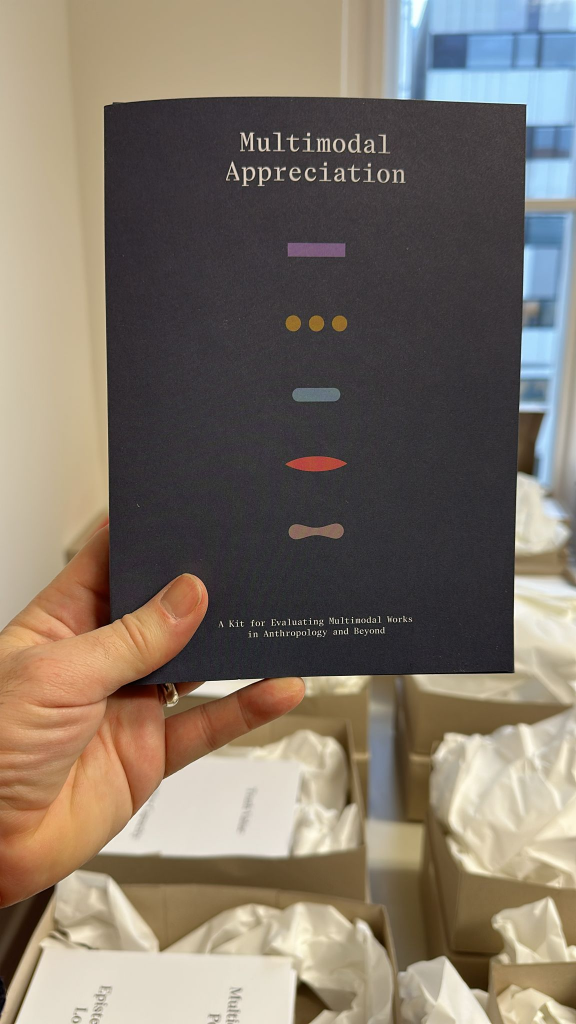
After more than a year of work writing and designing the kit, we have finally received the printed copies from the press!
Unboxing of the kit, picture by Andrew Gilbert
Written by Judith Albrecht, Tomás Criado, Ignacio Farías, Andrew Gilbert, Carla J Maier. Published CC BY SA Institut für Europäische Ethnologie · HU Berlin, 2025 [ISBN 978-3-00-084575-8]
This kit provides a set of practical exercises and a framework for valuing and assessing multimodal works. It recognizes their unique capacity to weave together and activate diverse media forms, collaborative practices, and public engagement while expanding the traditional boundaries of anthropological knowledge production.
This kit is intentionally designed as an open-ended, dynamic resource. We are certain that there are dimensions we have overlooked and anticipate that new dimensions will emerge through its use. This is why you’ll find blank cards, expandable lists, adaptable templates, and blank pages throughout the kit – they are invitations for you to contribute your own insights, document new approaches, and expand the kit based on your experiences in appreciating and evaluating multimodal works. Your engagement with the kit actively shapes its evolution, making it a lively and collectively enriched resource rather than a fixed set of instructions.
17-22 July 2024 | Hall Hub, Open University of Catalonia (UOC), Rambla del Poblenou 154, 08018 Barcelona
Photo: Interactive workshop at Medialab-Prado in Madrid (Medialab-Prado)
EASA is pleased to announce its first PhD summer school, supporting the development of early career scholars.
This will be held in Barcelona in the week before the 18th EASA Biennial Conference. The focus of the six-day school will be ethnographic experimentation.
Ethnographic experimentation is an anthropological response to the epistemic challenges of our contemporary world. Beyond traditional norms and forms of ethnography, there are all kinds of projects that experiment with forms of representation, fieldwork, and analysis. The ‘experiment’ emerges in all these ethnographies as a distinctive epistemic practice, different from observational activities that are the foundation for its empirical engagements. Experimentation is an opportunity to reconceptualise and transform the empirical practices of anthropology.
This summer school, organised by Adolfo Estalella and Tomás Criado, brings together a programme exploring the analysis, characterisation, and design of ethnographic experiments, along with opportunities to try them in practice. The school combines conceptual sessions with group debates and hands-on practical activities. Field experiments will be designed to respond to a situated ethnographic challenge. The school will foster a convivial atmosphere of mutual learning between participants and an openness to local actors with whom relevant approaches could be discussed and explored. Participants will be equipped with an analytic repertoire as well as a series of practical skills to attempt their own ethnographic experiments.
Funded and promoted by EASA. Organized by xcol. An Ethnographic Inventory Curated by Adolfo Estalella (UCM) and Tomás Criado (UOC)
Partners: Open University of Catalonia (UOC); Social Anthropology and Social Psychology Dept., Complutense University of Madrid (UCM); Anthropology Department, Spanish National Research Council (CSIC); Spanish Association of Social Anthropology (ASAEE)
Who can apply?: PhD students who are paid-up members of EASA. Selection will be based on application fit and diversity criteria.
Registration fee: €150. Dinners during the summer school are included.
Travel Bursary: partial travel bursaries will be available from EASA based on need.
How to apply: applicants are asked to explain how they plan to use, or have used, experimentation in their own PhD research. Apply here.
The application deadline is May 17 with the aim of communicating results by May 31.
**
Pedagogical proposal and methodology
The school combines theoretical sessions, debates and practical activities. Students will work in small groups on two sites/problems.
Theory, case, and debate sessions. These sessions are structured in three slots: a brief theoretical introduction (30 min.), a case that will be presented by a group of students (30 min.), and a debate (30 min.).
Hands-on activities in the field. Students will have to develop an experimental project during the week-long school. Groups will engage in two sites proposed by the school with the goal of making a brief empirical investigation and developing an ethnographic experiment.
Mentoring. Each group will have an assigned tutor who will discuss with them their experimental projects in daily meetings.
Self-managed dinner. The school will pay particular attention to the informal moments of social interaction, in this sense dinners will be a special moment to socialize. Participants will be in charge of organising it.
13.30 – 15.30. Lunch on site (each group on their own).
15.30 – 19.00. Activity in the field: devising devices.
19.00 – 20.00. Group debriefing meetings with tutors.
20.30. Dinner. Cooking together (self-managed).
Saturday, 20 July, 2024
10.00 – 13.30. Hands-on session: field site investigation.
13.30 – 15.30. Lunch on site (each group on their own).
15.30 – 19.00. Hands-on session: working on ethnographic accounts.
19.00 – 20.00. Group debriefing meetings with tutors.
20.30. Dinner. Cooking together (self-managed).Sunday
10.00 – 13.30. Hands-on session: field site investigation.
13.30 – 15.30. Lunch on site (each group on their own).
15.30 – 20.00. Hands-on session: working on ethnographic accounts.
20.30. Dinner. Cooking together (self-managed).
Monday, 21 July, 2024
10.00 – 13.30. Meeting with tutors: Hands-on session at UOC.
13.30 – 15.30. Lunch on site (each group on their own).
16.00 – 19.00. Public presentations of the group experiments.
20.00. Dinner and good-bye party.
Readings
1st session. Ethnographic experimentation: an introduction.
Tomás Sánchez Criado & Adolfo Estalella. 2018. Introduction. Experimental collaborations. In A. Estalella & T. S. Criado (Eds.), Experimental collaborations. Ethnography through fieldwork devices (pp. 1-30). New York, Oxford: Berghahn.
First case
Cantarella, L., Marcus, G. E., & Hegel, C. (2019). Ethnography by design: Scenographic experiments in fieldwork. Taylor & Francis. Introduction and Chapter 3.
2nd session. Ethnography, more than a method: Field devices for anthropological inquiry
Law, J. (2004). After Method: Mess in Social Science Research. Routledge. Introduction.
Law, J., & Ruppert, E. (2013). The Social Life of Methods: Devices. Journal of Cultural Economy, 6(3), 229-240.
Second case
Khandekar, A., Costelloe-Kuehn, B., Poirier, L., Morgan, A., Kenner, A., Fortun, K., & Fortun, M. (2021). Moving Ethnography: Infrastructuring Doubletakes and Switchbacks in Experimental Collaborative Methods. Science & Technology Studies, 34(3), 78-102.
3rd session. The ethnographic invention.
Estalella, A., & Criado, T.S. (2023). Introduction: The ethnographic invention. In T.S. Criado & A. Estalella (Eds.), An Ethnographic Inventory: Field Devices for Anthropological Inquiry (pp. 1-14). Routledge.
Third case.
Hartblay, C. (2020). I Was Never Alone or Oporniki: An Ethnographic Play on Disability. Toronto University Press. Introduction.
4th session. Styles of ethnographic experimentation.
Estalella, A. (n/d). The anthropological experiment (and the disappearing field of ethnography).
Fourth case.
Martínez, F. (2021). Ethnographic experiments with artists, designers and boundary objects: Exhibitions as a research method. UCL Press. Self-selected fragments.
5th session. Beyond text:Experiments on ethnographic expression.
Cox, R., Irving, A., & Wright, C. (Eds.) (2016). Beyond text?: Critical practices and sensory anthropology. Manchester University Press. Introduction.
6th session. Beyond representation: Experiments on multimodal anthropology.
Dattatreyan, E. G., & Marrero-Guillamón, I. (2019). Introduction: Multimodal Anthropology and the Politics of Invention. American Anthropologist, 121(1), 220-228.
Sixth case.
Farías, I., & Criado, T.S. (2023). How to game ethnography. En T. Sánchez Criado & A. Estalella (Eds.), An Ethnographic Inventory: Field Devices for Anthropological Inquiry (pp. 102-111). Routledge.
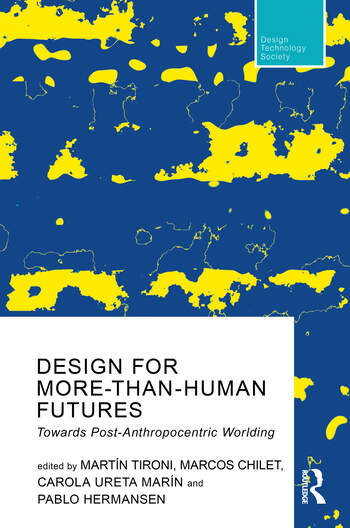
Martin Tironi, Marcos Chilet, Carola Ureta and Pablo Hermansen have edited a gem of a compilation, opening a space to think about the design of worlds that are not only human.
As the editors state, the book Design For More-Than-Human Futures: Towards Post-Anthropocentric Worlding, explores a “search for a transition towards more ethical design focused on more-than-human coexistence”, being “an invitation to travel new paths for design framed by ethics of more-than-human coexistence”. For this “Questioning the notion of human-centered design is central to this discussion. It is not only a theoretical and methodological concern, but an ethical need to critically rethink the modern, colonialist, and anthropocentric inheritance that resonates in design culture. The authors in this book explore the ideas oriented to form new relations with the more-than-human and with the planet, using design as a form of political enquiry”.
It was a luxury to be able to participate with a collective proposal that is as fun as it is challenging, together with long-time collaborators and mates Ignacio Farías and Felix Remter.
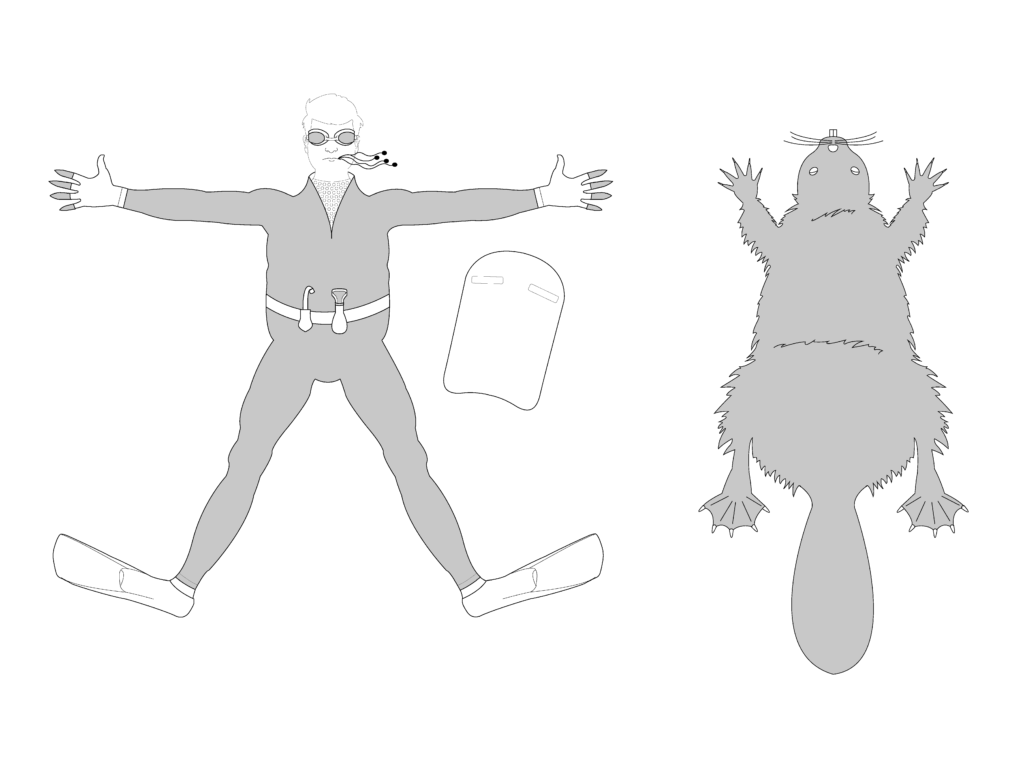
Our contribution describes a pedagogic experiment – part of the Design in Crisis: Sensing like an animal design studio at the TU Munich’s MA in Architecture in 2017 – where beavers were treated as epistemic partners for rethinking architectural practice, thus engaging their capacities in attempts at designing with them.
How would animals and architects co-design if we built the right contract?
In the face of multifaceted environmental crises of anthropogenic origins, recent developments in architecture and urbanism aim to explore other materials, technologies, resources, and modes of collaboration. Yet, what if what was at stake was not the redesign of architectural forms and urban landscapes, but the very redesign of urban design and architectural practice themselves? This chapter offers a collective speculation of this, where the “more-than-human” is treated as more than the content of a design brief; demanding instead an opening to other-than-human capacities in co-design processes and to the unpredictabilities resulting from terrestrial and multispecies interdependencies. How to care, then, in architectural practice for terrestrial and multispecies entanglements? Rather than providing guidelines or general principles to do so, this chapter describes an experimental approach to relearn architecture practice from animals. Following STS and environmental humanities multispecies concerns, it describes a pedagogic experiment where urban animals were treated as epistemic partners for rethinking architectural practice, thus engaging their capacities in attempts at designing with them.