Categories
atmosphere caring infrastructures collectives ecologies events experimental collaborations games heat and shade multimodal participatory & collaborative design of care infrastructures speculative futuring

Territorio Experimenta V

La próxima semana Tomás Criado, Irra-Rodríguez Giralt y Alejandro Limpo estaremos participando desde el CareNet (UOC) de Territorio Experimenta V, impulsado por el programa Cultura y Ciudadanía / Cultura y Ruralidades del Ministerio de Cultura.

Además de colaborar con una charla sobre las relaciones entre nuestros estudios de los desastres lentos, el papel de las ciencias sociales en estos contextos y nuestro interés por metodologías colaborativas y especulativas, estaremos participando como expertos del Eje 4. Cultura, mediación y construcción de futuros, facilitado por Fran Quiroga (Concomitentes).

Os dejamos toda la información y el programa de mano.
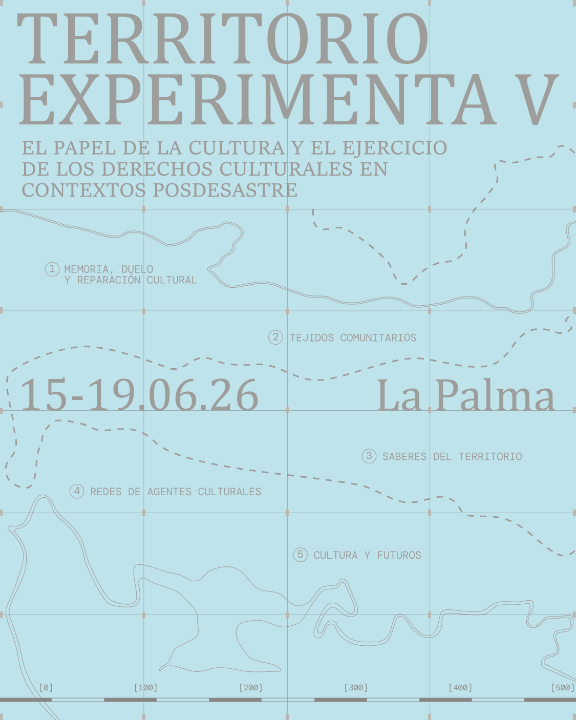
TERRITORIO EXPERIMENTA V: LABORATORIO DE EXPERIMENTACIÓN E INNOVACIÓN CULTURAL Y SOCIAL

El papel de la cultura y el ejercicio de los derechos culturales en contextos posdesastre

Los Llanos de Aridane, La Palma. Canarias.

15-19 de junio de 2026

Presentación

Territorio Experimenta V es un proyecto impulsado por el programa Cultura y Ciudadanía / Cultura y Ruralidades del Ministerio de Cultura. Su objetivo es generar un espacio de experimentación e intercambio de conocimiento desde el que articular iniciativas, herramientas, marcos y procesos de trabajo capaces de proyectar nuevas narrativas y respuestas culturales ante los retos del porvenir social, ecológico y territorial.

En esta edición, el proyecto explora la capacidad de la cultura para activar, reforzar y desarrollar vínculos entre memoria, arraigo, resiliencia, imaginación, innovación social y reactivación comunitaria, especialmente en situaciones de emergencia y posdesastre. Asimismo, presta atención a iniciativas orientadas a garantizar el ejercicio de los derechos culturales en estos contextos.

El foco se sitúa en territorios afectados por desastres naturales y fenómenos climáticos extremos que han transformado profundamente sus paisajes humanos, naturales y culturales. Entre ellos se incluyen el terremoto de Lorca (2011), la erupción volcánica de La Palma (2021), las DANAs en el Mediterráneo (2024), los incendios forestales de 2021, 2022 y 2025, así como las olas de calor y las sequías extremas.

Territorio Experimenta V en La Palma

Territorio Experimenta V se celebra en Los Llanos de Aridane, La Palma, del 15 al 19 de junio de 2026, con la colaboración del Cabildo de La Palma y el apoyo del Ministerio para la Transición Ecológica y el Reto Demográfico. El encuentro coincide con la celebración de la II Jornada de Buenas Prácticas en Patrimonio Cultural Inmaterial, organizada por el Instituto del Patrimonio Cultural de España del Ministerio de Cultura.

En esta edición, para el diseño del programa contamos con el apoyo de un comité asesor externo, conformado por:

  • Olga Blasco, profesora titular de Economía Aplicada de la Universitat de València y asesora científica del Ministerio de Cultura.
  • Carmen Grau, investigadora sobre prevención y gestión de desastres naturales en la Universidad de Waseda (Japón) y miembro del Observatorio Valenciano de Resiliencia Climática y Gestión de la Dana.
  • Marcia Jadue, investigadora y técnica de gestión del Observatori Cultural de la Universitat de València.
  • Rüdiger Ortiz, biólogo, técnico superior de evidencia científica para el Congreso de los Diputados a través de la Oficina de Ciencia y Tecnología (Oficina C) y asesor en el Ministerio para la Transición Ecológica y el Reto Demográfico.
  • Elena Pérez, profesora titular en la Universidad Europea de Canarias e investigadora principal del proyecto “Memoria, paisaje y futuro tras el volcán: patrimonio, turismo y comunidad en el Valle de Aridane”.
  • Fran Quiroga, investigador transdisciplinar y director de Concomitentes, programa que promueve y media en las relaciones entre artistas y sociedad civil.
  • Miguel Villalba, antropólogo social y cultural que, desde la investigación y la creación audiovisual, ha abordado las relaciones entre identidad, memoria colectiva y patrimonio en La Palma.

El laboratorio contará con la participación de 35 personas procedentes de diversos sectores, disciplinas y contextos, que trabajarán de manera colaborativa en el diseño de nuevas propuestas, herramientas y estrategias alineadas con los objetivos y ejes temáticos de esta edición. Este espacio de trabajo favorecerá el intercambio de conocimientos y experiencias, así como la articulación de enfoques interdisciplinarios para abordar de forma integral los retos planteados.

Además, Territorio Experimenta V incorporará una programación abierta al público que incluirá la presentación de proyectos y experiencias vinculadas al papel de la cultura en contextos de emergencia y transformación, impulsadas desde distintos territorios del país. Esta programación permitirá compartir el proceso de trabajo del laboratorio y socializar sus resultados, promoviendo el diálogo con la ciudadanía y ampliando el alcance e impacto de la iniciativa.

Antecedentes y marco institucional

El proyecto se inscribe en el programa Cultura y Ruralidades, que promueve el acceso, la creación y la participación cultural en todo el territorio, con especial atención al medio rural como espacio de innovación y desarrollo sostenible.

En este marco, Territorio Experimenta V surge como evolución de Rural Experimenta, una iniciativa iniciada en 2019 que ha impulsado laboratorios de innovación cultural en distintos territorios. Tras cuatro ediciones, el programa ha ampliado y abierto su enfoque y metodología, consolidándose como una plataforma para repensar el papel de la cultura en la transformación social, ecológica y territorial.

Esta iniciativa se enmarca, a su vez, en el Plan de Derechos Culturales, que reconoce la cultura como un bien común y un derecho fundamental, y promueve su ejercicio efectivo en condiciones de equidad, diversidad y participación. En este contexto, Territorio Experimenta V se alinea con estos principios al situar los derechos culturales en el centro de los procesos de innovación, intervención y reconstrucción territorial, especialmente en escenarios de crisis.

Enfoque metodológico

El laboratorio se concibe como una comunidad epistémica orientada a reconocer y amplificar las capacidades colectivas que emergen en contextos de crisis. No solo busca activar mecanismos de resistencia, sino también, y especialmente, restaurar la memoria e imaginar nuevas formas de convivencia y cuidado de las comunidades, sus entornos y sus culturas, garantizando al mismo tiempo sus derechos culturales.

A través de metodologías colaborativas y una dinámica basada en la inteligencia colectiva, las personas participantes explorarán el potencial de la cultura para generar narrativas renovadas, abrir vías de cuidado y reparación simbólica y material de comunidades, paisajes y patrimonios, así como ensayar respuestas que fortalezcan la vida en común ante escenarios de transformación acelerada y, a menudo, traumática.

Los resultados de este proceso de trabajo colectivo se recogerán en una publicación que sistematizará los aprendizajes, metodologías, herramientas y propuestas desarrolladas durante el laboratorio. Esta publicación estará orientada a facilitar la transferencia de conocimientos a otros territorios y contextos, así como a contribuir al diseño de políticas públicas, estrategias institucionales y prácticas culturales más eficaces en situaciones de emergencia y reconstrucción. Asimismo, se concibe como un recurso abierto que permitirá visibilizar experiencias, generar marcos de referencia compartidos y fortalecer redes de colaboración entre agentes culturales, administraciones y comunidades, ampliando el impacto del laboratorio más allá de su desarrollo presencial.

Ejes temáticos

Esta edición plantea una reflexión sobre el papel de la cultura y la garantía de los derechos culturales en contextos de emergencia y posdesastre. Como novedad, el enfoque se amplía más allá del ámbito rural para incorporar también entornos urbanos, reconociendo que las situaciones de emergencia afectan de manera creciente a ambos contextos.

Desde esta perspectiva, el proyecto propone un espacio de reflexión en torno al papel de la cultura y la creatividad comunitaria como herramientas de adaptación, y sobre cómo contribuyen a comprender, cuidar y reimaginar los territorios, así como a construir futuros en los que la vulnerabilidad pueda transformarse en una oportunidad para el encuentro, el aprendizaje y la transformación compartida.

En este marco, se establecen cuatro ejes temáticos de trabajo:

Eje 1. Cultura como dimensión estructural en la gestión de emergencias y reconstrucción

Este eje propone integrar de manera efectiva la dimensión cultural y patrimonial en las estrategias, planes y herramientas de gestión del riesgo de desastres y reconstrucción, tomando como referencia el Marco de Sendai para la Reducción del Riesgo de Desastres (2015–2030) y la normativa estatal y autonómica aplicable (como el artículo 19 de la Ley 5/2025, de Volcanes de Canarias).

Se plantea incorporar la cultura en todas las fases de la gestión integral —prevención, mitigación, respuesta, recuperación y memoria— superando su consideración limitada a procesos posteriores de reparación simbólica. Se parte del reconocimiento de que las catástrofes afectan no solo a infraestructuras y ecosistemas, sino también a paisajes culturales, imaginarios, memorias y prácticas comunitarias.

La cultura se sitúa, así, como un eje estratégico para fortalecer la resiliencia territorial, el cuidado emocional, la reactivación del tejido social y la garantía de derechos, contribuyendo a procesos de reconstrucción más sostenibles, inclusivos y vinculados a las comunidades afectadas.

Eje 2. Protección y activación del ecosistema cultural

Este eje se centra en la identificación y sistematización de aprendizajes derivados de experiencias recientes, como la red de asesoramiento y acompañamiento al sector cultural valenciano tras la DANA, mediante el análisis de procesos, medidas y mecanismos de coordinación desplegados en contextos de emergencia.

A partir de ello, se busca definir herramientas de respuesta y colaboración institucional y sectorial que permitan articular una hoja de ruta para la activación del ecosistema cultural. Esto incluye mecanismos de financiación, modelos de gobernanza, instrumentos de apoyo al sector y estrategias de reactivación cultural.

Asimismo, se reconoce el papel clave de las redes asociativas por su capacidad de articulación, movilización de recursos y mediación entre la sociedad civil y las administraciones públicas. El eje incorpora también el desarrollo de sistemas de información e indicadores que faciliten la planificación, evaluación y sostenibilidad de las políticas culturales, así como la formulación de recomendaciones operativas para mejorar la preparación, respuesta y recuperación ante futuras crisis.

Eje 3. Cultura, mediación y memoria colectiva

Este eje aborda el papel de la cultura en la preservación y activación de la memoria social y cultural en contextos de desastre. Se orienta a identificar y analizar iniciativas que contribuyan a sostener estas memorias, extrayendo aprendizajes y estrategias transferibles para fortalecer la resiliencia comunitaria.

Se reconoce el potencial de la mediación y de las prácticas artístico-culturales como herramientas de cuidado, acompañamiento emocional y elaboración colectiva del duelo, favoreciendo espacios de escucha, reconocimiento y reconstrucción social.

Asimismo, se plantea la memoria del desastre como un elemento clave para evitar el olvido y la pérdida de saberes y experiencias, promoviendo su integración en los relatos colectivos. Esto incluye la recuperación de biografías, archivos y patrimonios familiares, así como la incorporación de aprendizajes intergeneracionales que refuercen los vínculos comunitarios y el arraigo territorial.

Eje 4. Cultura, mediación y construcción de futuros

Este eje se orienta a la reconstrucción cultural y simbólica desde una perspectiva de futuro, mediante la identificación y análisis de iniciativas que impulsen nuevas narrativas y formas de habitar los territorios afectados, aprovechando aprendizajes y estrategias transferibles.

Se promueve el desarrollo de procesos culturales y artísticos arraigados en las comunidades, basados en metodologías participativas, inclusivas y no extractivistas, que partan de la escucha activa y se ajusten a los tiempos y necesidades del territorio, contribuyendo a reforzar el tejido social y la identidad colectiva.

Asimismo, el eje impulsa la imaginación, la cocreación y la acción colectiva como formas de generación de conocimiento situado, favoreciendo la construcción compartida de nuevos imaginarios. Desde el reconocimiento de la cultura como una infraestructura relacional clave en contextos de transformación, se busca aplicar estos aprendizajes a los desafíos del cambio climático y la transición ecológica, promoviendo formas de vida más adaptativas, sostenibles y orientadas al futuro.

PROGRAMA: PDF
Categories
city-making ecologies ecologies of support ethnographic experimentation events games older people urban and personal devices

Taller «Ciudades que envejecen» @ Setmana de l’Antropologia 2025

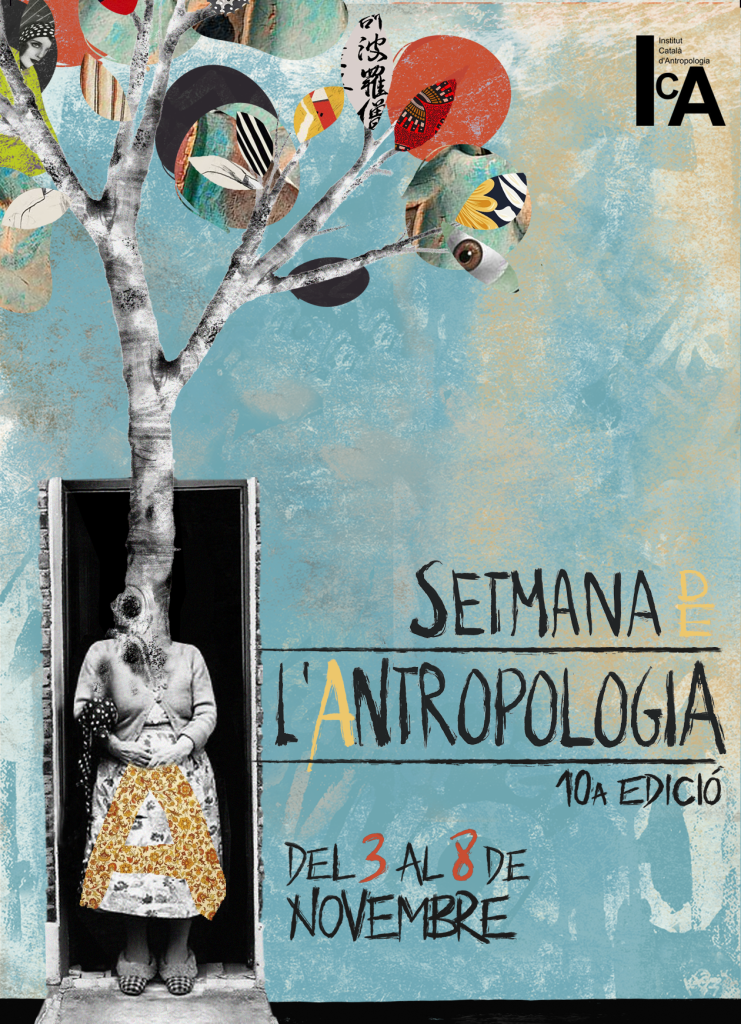
En el proyecto CIUDEN participamos de la Setmana de l’Antropologia 2025 organizada por el Institut Català d’Antropologia (ICA) con una activación del juego de mesa «Ciudades que envejecen», una dinámica de juego especulativo creada específicamente para este proyecto como metodología etnográfica. El dispositivo se jugó por primera vez en junio de 2025 durante unos talleres con agentes que intervienen directamente en las transformaciones urbanas vinculadas al envejecimiento. En esta ocasión, llevamos el juego a un entorno disciplinar abierto al público como propuesta de herramienta metodológica especulativa para la investigación antropológica.

Este taller es una invitación a imaginar posibles futuros del envejecimiento en las ciudades litorales mediterráneas a través de un juego de mesa. A partir de esta propuesta buscamos fomentar el diálogo transdisciplinar e intersectorial para pensar horizontes posibles de los retos urbanos demográficos, ambientales, de vivienda, de movilidad y de equipaciones y servicios.

Lugar: Museu Etnològic i de Cultures del Món – Sede Montcada (Carrer Montcada, 12-14, Barcelona).

Actividad con inscripción previa aquí.

Martes 4/11/2025 | 10:00h-13:30h | presencial

Categories
caring infrastructures city-making collectives ethics, politics and economy of care events games multimodal older people participatory & collaborative design of care infrastructures urban and personal devices

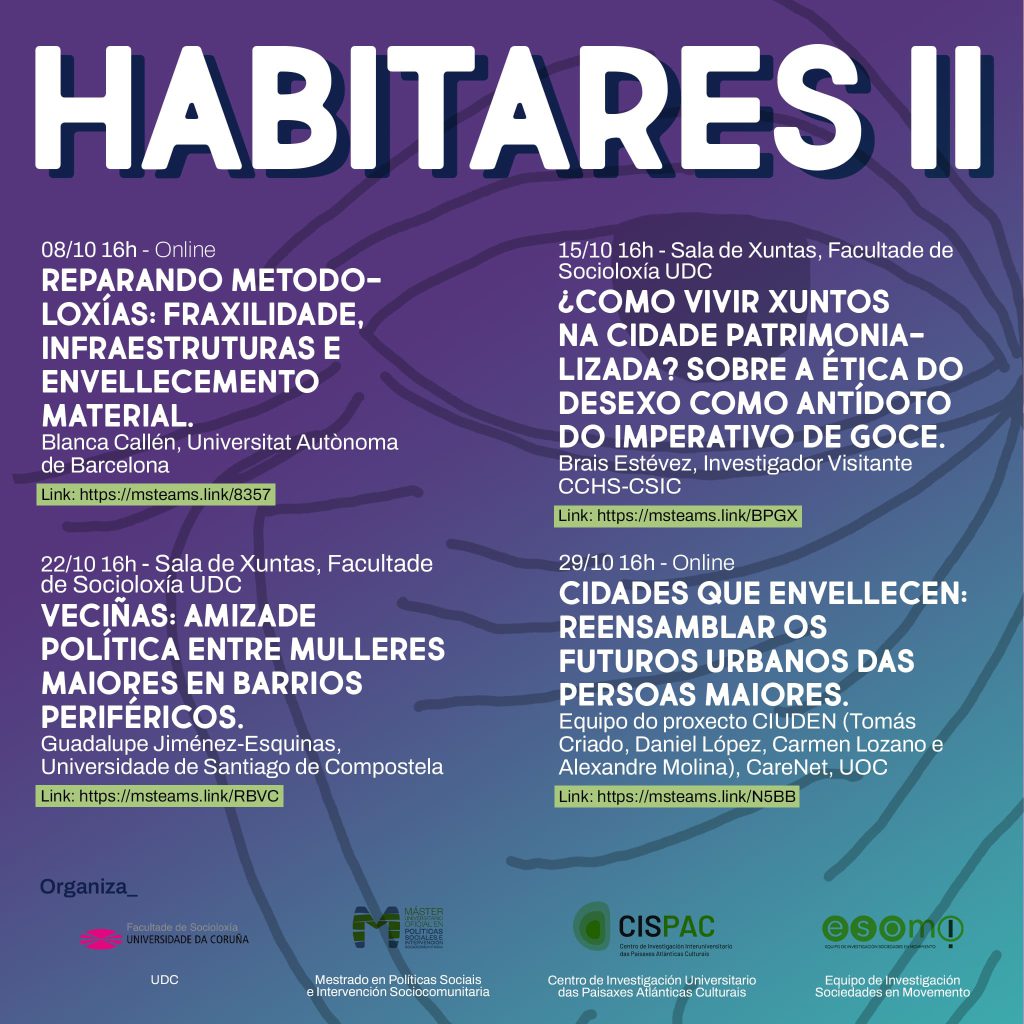
Ciclo HABITARES II @ Universidade da Coruña

El equipo del proyecto CIUDEN participamos en el ciclo HABITARES II, organizado por el Equipo de Investigación Sociedades en Movimiento en el marco del Maestrado en Políticas Sociais e Intervención Sociocomunitaria de la Universidade da Coruña con la sesión «Cidades que envellecen: reensamblar os futuros urbanos das persoas maiores».

Acceso a la sesión: https://msteams.link/N5BB

29/10/2025 | 16:00h | online

Categories
atmosphere ecologies ecologies of support events games inventory more-than-human open sourcing techniques & ways of doing urban and personal devices

A Publics’ Anthropology: Setting Up Ecologies of Collective Speculation

Thanks to the gracious invitation by Gabriele Alex (Uni Tübingen), last April 12, 2024 I had the chance to give an online lecture at the Civis (Europe’s Civic University Alliance) “Social Sciences Going Public – Research and Practice with, in and for the Society” Summer School 2024.

I took the occasion to share my vision for what I have been calling not Public Anthropology but, rather, A Publics’ Anthropology!

A Publics’ Anthropology: Setting up ecologies of collective speculation

What does it mean to undertake anthropological work in contemporary domains populated by a wide variety of ‘publics’, ranging from technical experts to affected communities? Publics are perhaps the main collective condition of knowledge production and circulation in the contemporary: not just as media-provoked entities–e.g. the ‘public sphere’ or scientific and professional societies, connected through ‘publications’–, but also the many uncertain and emergent collectives that gather in different degrees of involvement under issues of concern, using a variety of mediums. As I see it, an anthropology aware of its public dimension should not just be one engaging in public criticism, but also, and perhaps mainly, one transformed by the very relation to publics, developing different forms of engagement and exploring different aims and effects. In my work, I have been inspired to do this in activist design endeavours with different kinds of urban agents. To discuss the different forms a publics’ anthropology might entail, in this session I’ll share with you two recent projects working with municipal actors setting up ecologies of collective speculation: the game Waste What?, an interdisciplinary team production as part of studying activist circular economy projects in Berlin, searching to simulate the conundrums of these initiatives as well as provoke a reflection on their predicaments; and the Department of Umbrology, a collective speculative experiment equipping a proto-municipal division to inquire on the social dimensions of heat mitigation projects, in the hope that his might sensitise technical professionals to consider the social in the plural.

Categories
games multimodal publications

Multimodal Values: The Challenge of Institutionalizing and Evaluating More-than-textual Ethnography

The last issue of the wonderful journal project entanglements: experiments in multimodal ethnography came with the sad news that they’re closing down shop. It’s perhaps telling that our call for institutionalising more-than-textual ethnography appears in that very last issue. Perhaps it symbolically means that there’s loads of work to be done for multimodality to thrive.

This is also a text that came to be published as I discovered I would be moving to greener career pastures, after many wonderful years developing the vision we here present, and that I hope I can continue to work on as associate researcher of the Stadtlabor for Multimodal Anthropology.

Many thanks to Ignacio Farías, Julia Schröder and our many collaborators in different projects for their inspiration to think together more-than-textual anthropological worlds!

The end is the beginning is the end is the beginning!

Abstract

In this collective text, we introduce the vision and work of the Stadtlabor for Multimodal Anthropology at the Humboldt-University of Berlin and propose to explore the values of multimodal ethnographic projects, broadly construed. Thinking from our very explorations in multimodal production, foregrounding a concern on values is critical to share a conundrum that has been haunting us in recent times. Indeed, while engaging in various multimodal projects, we have been confronted with a predicament that we assume many multimodally-invested colleagues must have faced at some point: the problem of how to evaluate and even institutionalize multimodal anthropological projects. This question has started to become pressing when discussing our projects in different academic contexts. In what follows, we aim to expound and discuss the particular challenges of evaluating multimodal productions and thus of institutionalizing values for the multimodal. 

Keywords: valuation, ethnography, multimodality, evaluation, Institutionalization

Recommended citation: Criado, T., Farías, I. and Schröder, J. (2022). ‘Multimodal Values: The Challenge of Institutionalizing and Evaluating More-than-textual Ethnography’, entanglements, 5(1/2): 94-107 | PDF

[Klicken Sie hier für eine deutsche Version dieses Textes]

Categories
city-making experimental collaborations games materials multimodal open sourcing

House of Gossip > Open-source game developed by the Stadtlabor for Multimodal Anthropology

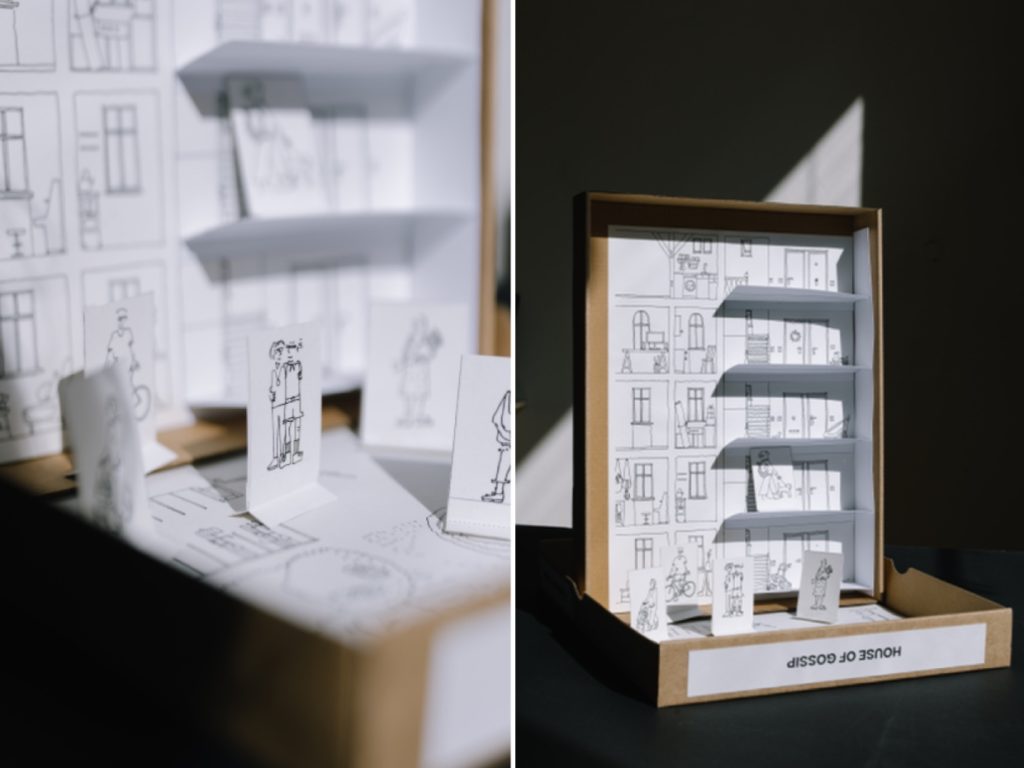
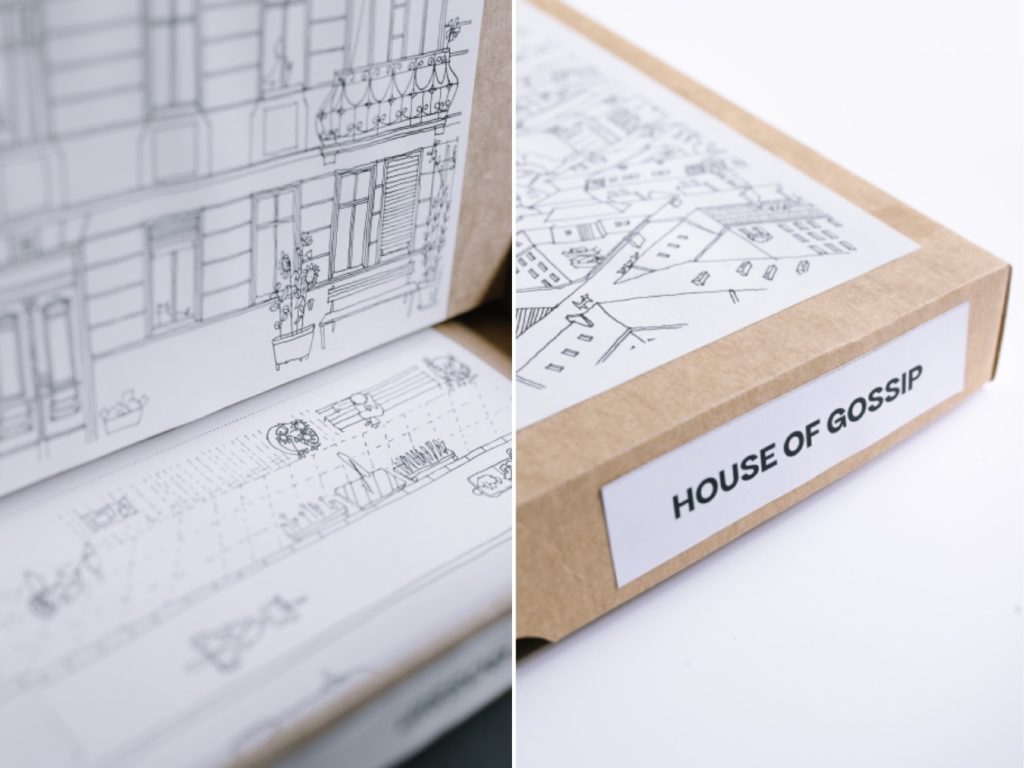
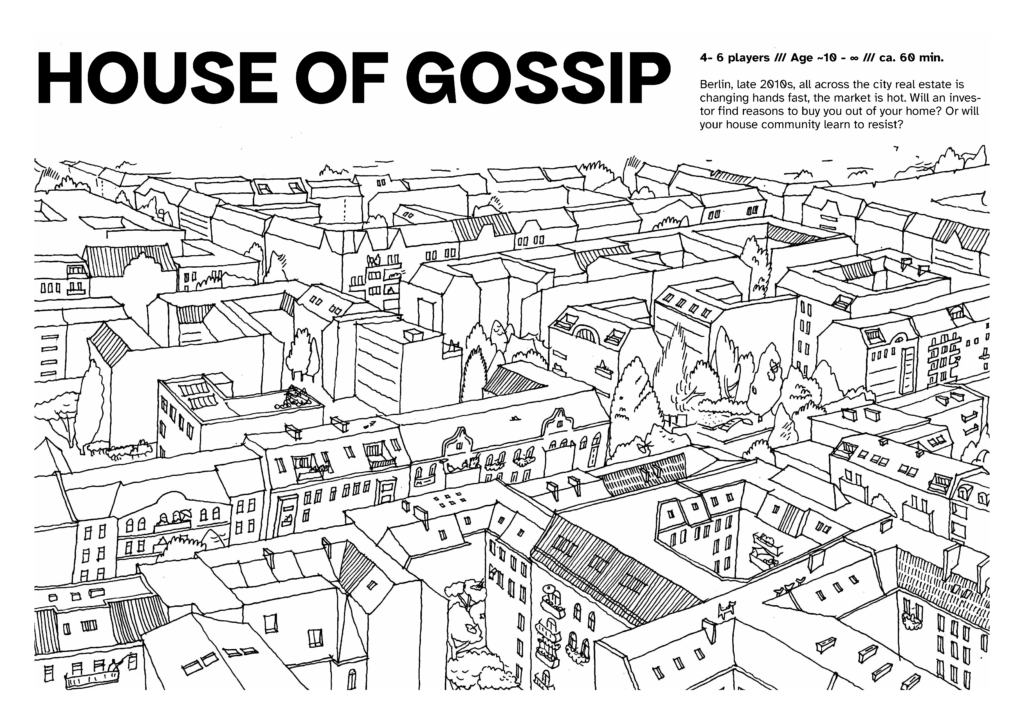
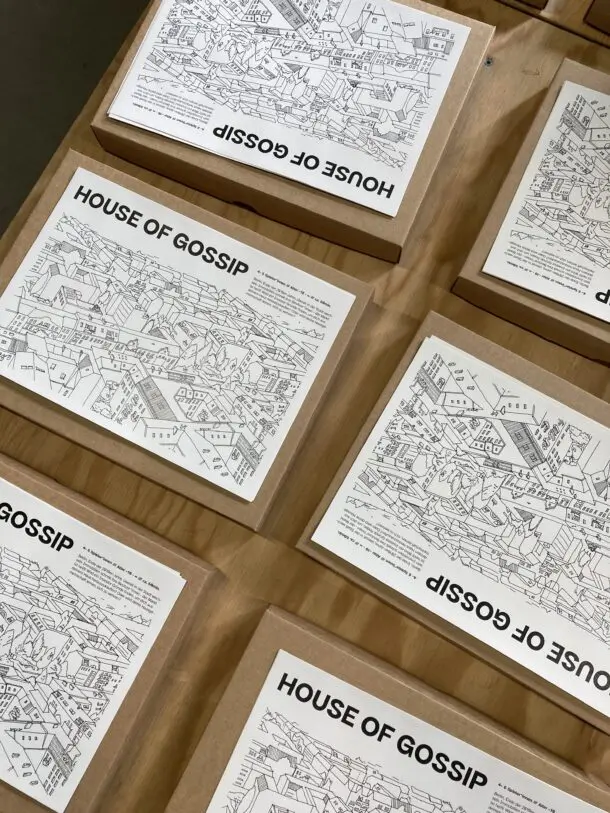
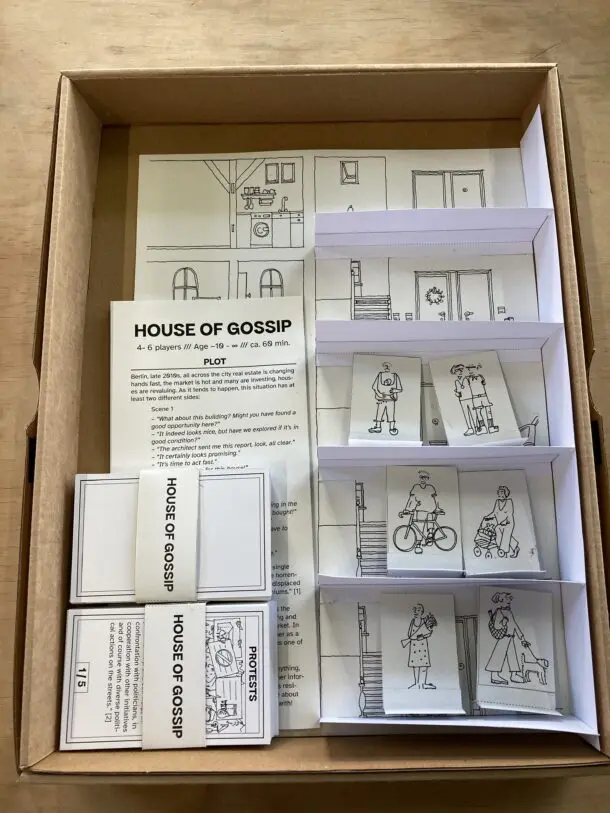
House of Gossip is an open-source downloadable game (developed by the Stadtlabor for Multimodal Anthropology of the HU Berlin) that stages and creates the grounds for reflection on conflicts regarding housing and the different viewpoints in a volatile real estate market.

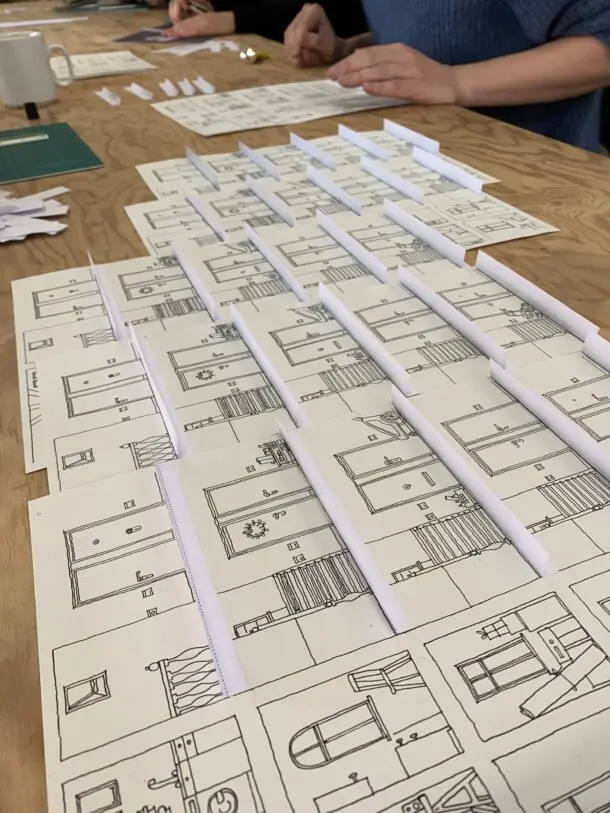
A first prototype of the game was developed – in collaboration with colleagues at the Zentrum für Kunst und Urbanistik (ZK/U) – in a hackathon together with MA students of the Studienprojekt “The only game in town? Anthropology and the housing markets in Berlin” (2018-2019) at the Institut für Europäische Ethnologie (HU Berlin), and showcased in the “Open Form neu denken” exhibition (organized by Z/KU at the Werkstatt of Haus der Statistik in October 25–27 2019). In the last two years we’ve been working on creating a downloadable and playable version of it.

Credits

Game concept (in alphabetical order): Tomás Criado, Ignacio Farías, Lena Heiss, Marie Aline Klinger, Lilian Krischer, Leonie Schipke & Tan Weigand. 

Game art by Vasylysa Shchogoleva

CC BY NC SA 2021 Stadtlabor for Multimodal Anthropology, HU Berlin

Context

Berlin, late 2010s, all across the city real estate is changing hands fast, the market is hot and many are investing, houses are revaluing. As it tends to happen, this situation has at least two different sides:

Scene 1

– “What about this building? Might you have found a good opportunity here?”
– “It indeed looks nice, but have we explored if it’s in good condition?”

– “The architect sent me this report, look, all clear.” – “It certainly looks promising.”
– “It’s time to act fast.”
– “Ok, yes, let’s go for this house!”

Scene 2

– “Hi, how was your day?”
– “Nothing special, yours?”
– “I heard rumours, two neighbours speaking in the corridor: the building is finally going to be bought!” – “Yes, there was a letter in the mail, look”.
– “But… What will happen to us? Will we have to move if they raise the rent?”
– “We have to do something…”
– “But we know nearly no one in the house.”

“When an apartment building is to be sold, every single alarm bell sets off for the residents. In view of the horrendous purchase prices, there is a danger of being displaced by higher rents or even conversion into condominiums.”

Rationale

House of Gossip is  an open-source downloadable game that stages and creates the grounds for reflection on conflicts regarding housing and the different viewpoints in a volatile real estate market. In the game, you will have the opportunity to play either as a resident of the house or as a covert buyer, acting as one of the house’s residents.

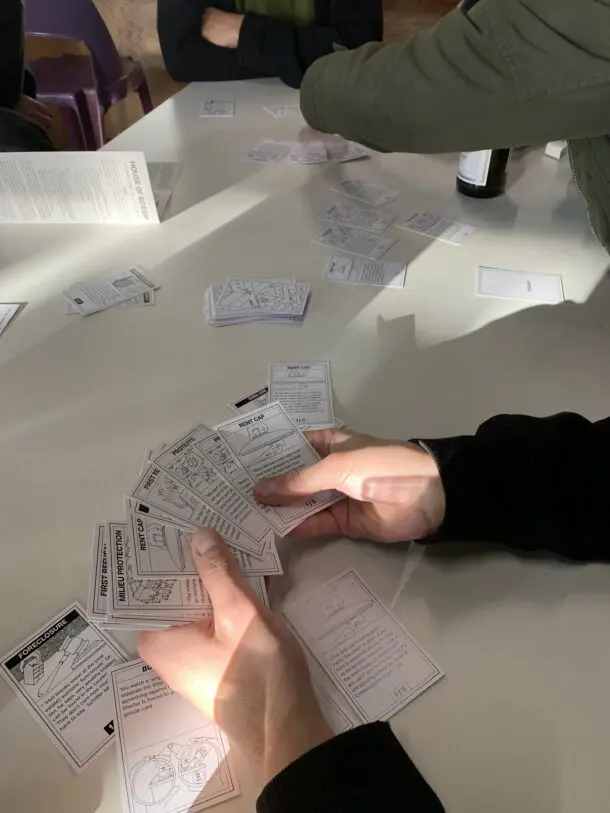
In a process where no one can be certain about anything, gossip abounds: In the game you will have to gather information form alliances and find your way to save (as residents) or buy (as the buyer) the house! Think twice about who and when you want to share your information with!

During the course of the game you will repeatedly encounter your neighbours in the stairway to exchange gossip. Your main goal is not just to understand to whom you’re talking to, but also to perform in front of others and form alliances for one of the two competing purposes of the game: Buying or saving the house.

Those who manage to gather the necessary gossips will in the end win the game. Will the house community manage to resist or could the buyer succeed in acquiring the new property?

Download links

The games files can be downloaded here below

Assembly instructions

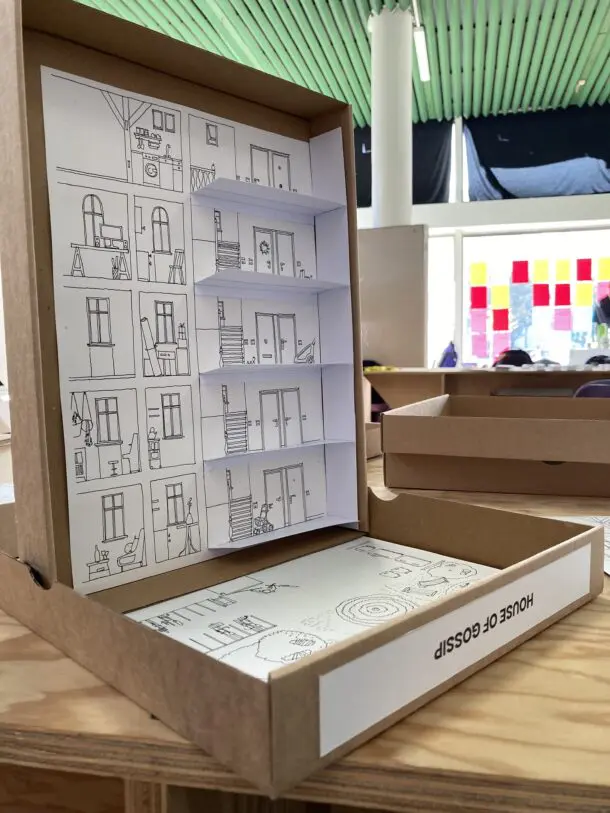
In order to build your own House of Gossip board game, you will need the following:

● Box A4 size or 23.5 x 31.5 x 3.7 cm
● Paper cutting knife
● Paper cutting board
● Ruler
● Glue suitable for paper and cupboard
● Printing paper (170 g/m2 and 200g/m2 or higher, eco-paper is advised)
● Ink jet or laser printer filled with black ink

  1. Download the necessary game parts:
    ● Game Instructions
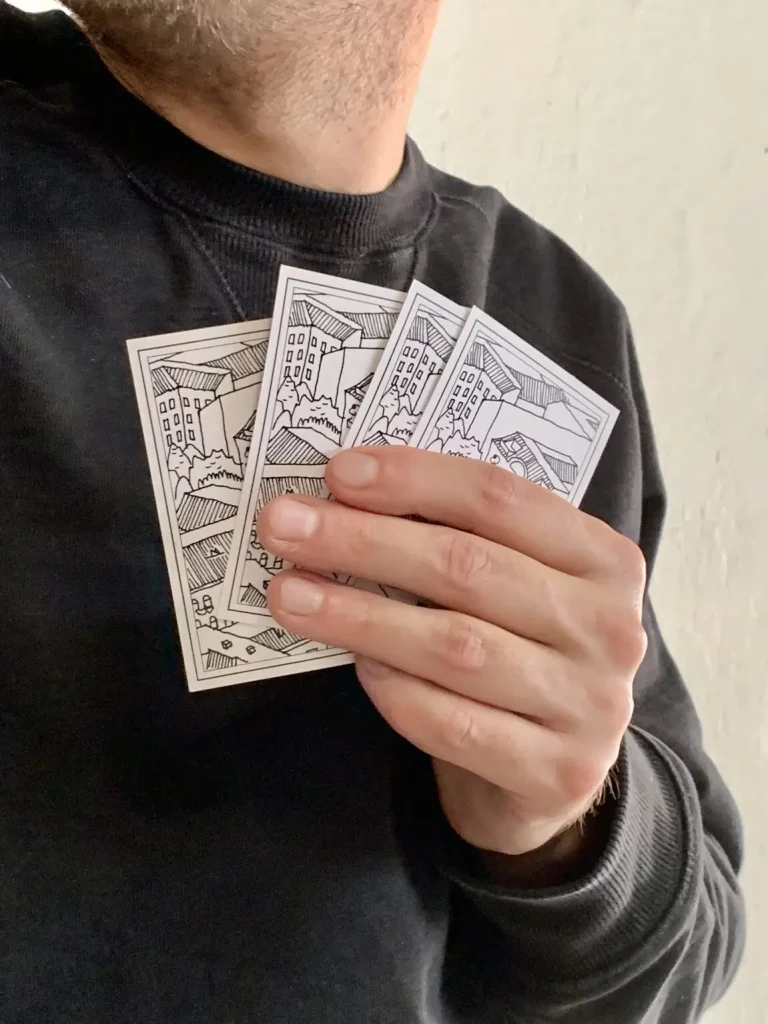
    ● Playing Cards
    ● Board/Box and Tokens
  2. Print out the downloaded parts. You can print all part on the 170 g/m2 or higher eco paper, unless other is stated:

○ Game Instructions
It is an A4 double-sided print. Fold it in three parts, following the dashed lines markings at the top and bottom of the paper.

○ Playing Cards
It is an A4 double-sided print. Advised paper thickness for this element is 350 g/m2, but if you don’t have such paper, use the 170 g/m2 or higher eco paper.
Cut the cards following the black markings on the sheet. In the end, you must have cards that are 59 x 92 mm big.

○ Board/Box and Tokens
It is an A4 one-sided print. All the prints, except the file called “HoG_Staircase-Cutout_A4_ENG.pdf” can be printed on the 170 g/m2 or higher eco paper. The file “HoG_Staircase-Cutout_A4_ENG.pdf” should be printed on 200/220 g/m2 or higher eco paper. This will ensure the stability and longevity of the board. After all the parts are printed, do the following:

A. Glue the “HoG_Box-Top_A4_ENG.pdf” file on the top of your box. You can adjust it in the middle if the box is bigger than A4.
B. Glue the “HoG_Box-Top-Inside_A4_ENG.pdf” file on the inner side of the top part of the box.
C. Glue the “HoG_Box-Back_A4_ENG.pdf” file on the outer back part of the box.
D. The files “.pdf” and “.pdf” need to be cut out following the black lines markings, while the dashed line markings are for folding (in order to have an easier folding, you can first use the paper cutter and applying not full, but medium pressure, prepare the paper for folding). For the more detailing step-by-step instruction on the staircase assembly, following the pictures (video, in case applicable).

Categories
events games multimodal

Playing with method: Game design as ethnographic research

The Stadtlabor for Multimodal Anthropology (HU Berlin) hosts Playing with method: Game design as ethnographic research, a series of live-streamed events on 14.1, 28.1 & 11.2.2021

+info: https://hu.berlin/playingwithmethod

Rationale of the workshop

What if in the face of very serious topics we developed conceptual, speculative and material tools, such as games, to find ways of intervening as ethnographers, social scientists or as activists in current design dynamics? 

The series of talks Playing with method wishes to open up a line of inquiry counting on practical examples (be they card, board, performative or video-games) theoretical repertoires, and speculative visions or positional arguments to address the promises and challenges of the ways in which games might be mobilized for different forms and genres of social intervention. 

In spite, or even because of their ludic dimension, we want to explore to what extent games might be capable of altering how we discuss issues, share knowledge, raise awareness, make problems public, imagine futures, and learn to care. Thus, we would like to collectively discuss critically on the contemporary cultural role of games, with the aspiration to ponder how games could redevelop our repertoires of ethnographic representation and intervention; or what vocabularies and considerations might allow us to unfold their full potential as relevant ethnographic or peri-ethnographic genres. 

What is more, we are particularly interested in how games open up a Spielraum (a degree of play) for transgressing the boundaries of academic disciplines and reinventing what research might mean.

Why this workshop now?

In the last years, members of the Stadtlabor for Multimodal Anthropology have been approaching the potentialities and challenges of games as particular platforms or devices for anthropological research / intervention for the real estate crisis in Berlin. In our work not only we have been inspired by the activist/ pedagogic impetus of the Landlord’s Game (anti-monopolistic predecessor of Monopoly), but also by different works around games by social designers, artists and other anthropologists wishing to expand the reach of forms of urban intervention.

The games we have developed are not final products but open prototypes. They are result and method of our research, and work as devices to intervene in urban development processes. As such, they are open to be transformed and re-versioned, so that their specific languages, logics, gameplay, and effects could be adapted to specific situations and concerns of various urban actors.

In collaboration with ZK/U, we have produced a series of games, most centrally featuring House of Gossip, which re-enacts the threat of displacement of tenants from their homes, plunging us into the rumors circulating in a stairway and their truth effects. 

Drawing from our own work, for this series of talks we would like to gather around inspiring examples so as to discuss and discover together how developing games might also impact how we could do social-cultural research: from describing to intervening, from representing to performing (and breaching) reality, thus experimenting with what politics and critique might mean whenever we prototype and play.

Programme

14.1.2021 5-7pm – Urban matters (FB event)

Claudia Hummel (UdK & Spielclub Oranienstraße 25 / nGbK project group)

Tomás Criado & Ignacio Farías (Urban Anthropology, HU Berlin)

Chaired by Julia Schröder (Urban Anthropology, HU Berlin)

28.1.2021 6-8pm – Educational matters (FB event)

Judith Ackermann (Fachhochschule Potsdam)

Joe Dumit (UC Davis)

Chaired by Tomás Criado (Urban Anthropology, HU Berlin)

11.2.2021 5-7pm – Organizational matters (FB event)

Judith Igelsböck (Institut für Organisation, JKU Linz) & Friedrich Kirschner (HFS ‚Ernst Busch‘, Berlin)

Alberto Vanolo (Università degli Studi di Torino)

Chaired by Ignacio Farías (Urban Anthropology, HU Berlin)

[Updated February 2021]