Gracias a la amable sugerencia de la Prof. Dra. Vivette García Deister he sido convidado como profesor invitado de la UNAM en agosto de 2025, a través del apoyo PAEP 2025.
No sólo tendré el gran placer de viajar a Ciudad de México para conocer a un grupo fascinante de doctorandes, trabajando sobre muy diferentes proyectos etnográficos en el ámbito de los STS y el cuerpo, la salud y las ciencias biológicas, sino que esta será una gran oportunidad de poder compartir y poner en discusión mis investigaciones en curso en el Laboratorio de Estudios de la Ciencia y la Tecnología que la Dra. García Deister coordina como parte del Posgrado en Filosofía de la Ciencia.
¡Una gran ocasión para tramar alianzas sobre inventiva etnográfica y los STS en lengua castellana!
Para quien pudiera interesar, adjunto los detalles.
PROGRAMA
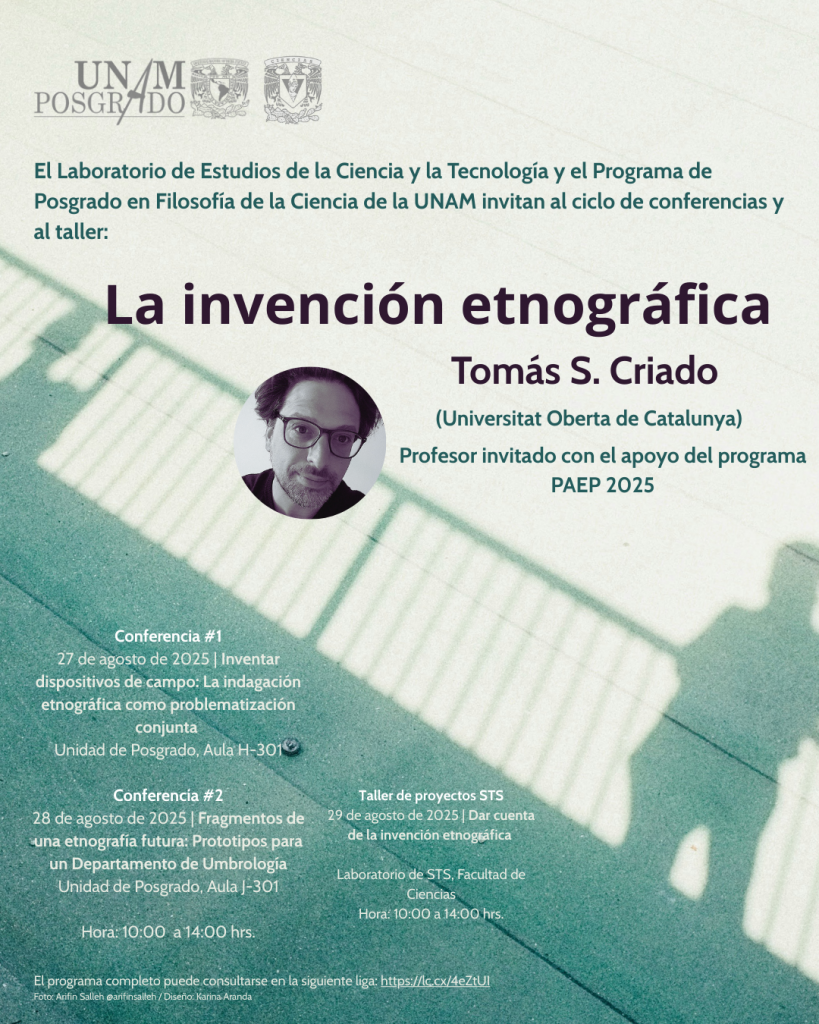
A través del apoyo PAEP 2025, el Laboratorio de Estudios de la Ciencia y la Tecnología de la Facultad de Ciencias y el Programa de Posgrado en Filosofía de la Ciencia de la UNAM convocan al ciclo de conferencias y al taller: La invención etnográfica, que impartirá el Dr. Tomás Criado, en el marco del Seminario de Posgrado Aproximaciones teórico-metodológicas a los STS, a cargo de la Dra. Vivette García Deister y el Dr. Alexis Bedolla Velázquez.
Conferencia #1 27 de agosto de 2025 | Inventar dispositivos de campo: La indagación etnográfica como problematización conjunta
En esta conferencia me gustaría poder repasar el programa sobre la etnografía que une mis más recientes compilaciones (Experimental Collaborations y An Ethnographic Inventory): un trabajo co-desarrollado con mi colega Adolfo Estalella que pone de evidencia la centralidad conceptual y descriptiva de pensar la etnografía desde sus “dispositivos de campo”, esto es, desde las disposiciones afectivas, así como los arreglos sociales y materiales que hacen la etnografía posible. Un trabajo descriptivo y conceptual que nos muestra la etnografía como un trabajo relacional que convierte a los Otros en acompañantes epistémicos de una problematización conjunta del mundo.
Lecturas
Para esta sesión recomiendo las dos introducciones de los libros:
– Criado, T. S., & Estalella, A. (2018). Introduction: Experimental Collaborations. En A. Estalella & T. S. Criado (Eds.), Experimental Collaborations: Ethnography through Fieldwork Devices (pp. 1-30). Berghahn.
– Estalella, A., & Criado, T. S. (2023). Introduction: The ethnographic invention. En An Ethnographic Inventory (pp. 1-14). Routledge.
Para profundizar, sugiero los siguientes capítulos en que me apoyaré en mi conferencia:
– Marrero-Guillamón, I. (2018). Making fieldwork public: Repurposing ethnography as a hosting platform in Hackney Wick, London. En A. Estalella & T. S. Criado (Eds.), Experimental Collaborations: Ethnography through Fieldwork Devices (pp. 179-200). Berghahn.
– Pérez-Bustos, T. (2023). How to stitch ethnography. En T. Criado & A. Estalella (Ed.) An Ethnographic Inventory. Field Devices for Anthropological Inquiry (pp.192–199). London: Routledge.
– Farías, I. y Criado, T. (2023). How to game ethnography. En T. Criado & A. Estalella (Ed.) An Ethnographic Inventory. Field Devices for Anthropological Inquiry (pp. 102–111). London: Routledge.
– Pierotti, G. y Giordano, C. (2023). How to get caught in the ethnographic material. En T. Criado & A. Estalella (Ed.) An Ethnographic Inventory. Field Devices for Anthropological Inquiry (pp. 102–121). London: Routledge.
Conferencia #2 28 de agosto de 2025 | Fragmentos de una etnografía futura: Prototipos para un Departamento de Umbrología
En esta conferencia quisiera poder hablaros de mi proyecto más reciente en curso, una colaboración con el Ayuntamiento de Barcelona que, en sus planes de adaptación climática, ha puesto de manifiesto la importancia del diseño de las sombras, convirtiéndolas en una Zona Crítica del cuidado urbano contemporáneo.
Concepto
En muchos lugares del mundo, el calor ha dejado de ser un evento meteorológico abstracto, recurrente o estacional. Las mutaciones climáticas del presente están alterando nuestras culturas climáticas, con efectos desiguales y devastadores, requiriendo innumerables exploraciones sobre cómo articular formas de vida futura más plurales y cuidadosas. En un momento en que los profesionales del diseño y las administraciones se esfuerzan por encontrar adaptaciones urbanas futuras, las personas que trabajamos en el ámbito de los STS con una perspectiva etnográfica también tenemos un importante papel que poder jugar. Sin embargo, esto puede requerir adaptaciones cruciales de nuestra práctica etnográfica.
Convencionalmente descrita como una práctica empírica, inmersiva y de naturaleza documental, con un objetivo descriptivo, hecha en el presente aunque atenta a las ramificaciones pasadas de los hechos observados, ¿cómo tomar en serio la necesidad de estudiar y de afectar al futuro del diseño urbano? En mi opinión, no sólo necesitaremos buenas descripciones, sino también una “etnografía futura”: con enfoques más prospectivos y especulativos, buscando afectar las sensibilidades de los profesionales del diseño urbano, para evitar que las llamadas a la acción desde el campo del diseño se impongan tecnocráticamente (es decir, sin considerar la multiplicidad de nuestras prácticas urbanas).
Como parte de un trabajo etnográfico en los últimos dos años acompañando iniciativas de diseño de sombras en el espacio público en Barcelona, he sentido la necesidad imperiosa de responder a los prototipos urbanísticos con el prototipado de un espacio etnográfico colectivo: el “Departamento de Umbrología” (https://umbrology.org/), una entidad ficcional inspirada en la investigación artística, que trata de contribuir a la futurización especulativa de nuestras formas de habitar cuidadosamente en entornos urbanos recalentados; y lo hace mediante dispositivos de campo etnográficos como talleres de co-creación, juegos observacionales, paseos experienciales y prácticas de dibujo atmosférico en las que no sólo describimos las ciudades de las sombras del presente. También tanteamos especulativamente fragmentos de una etnografía futura, sensibilizándonos a la importancia que tendrán las sombras en las transformaciones del cuidado urbano.
Referencias (para profundizar tras la conferencia, haré mención a argumentos que aquí aparecen)
Criado, T. S. (2021). Anthropology as a careful design practice? Zeitschrift für Ethnologie, 145(2020, 1), 47-70.
Criado, T.S. (2024). The City of Shades: Ethnography of Urban Habitability in Times of Climate Mutation. Tarde, a handbook of minimal and irrellevant urban entanglements, 6. URL: https://tarde.info/the-city-of-shades/
29 de agosto de 2025 | Taller: Dar cuenta de la invención etnográfica de proyectos del Laboratorio de STS la UNAM
Hora y Lugar
10:00-14:00, Facultad de Ciencias UNAM, Laboratorio de Estudios de la Ciencia y la Tecnología
Concepto
En esta sesión quisiera aprender de vuestra inventiva en los trabajos en curso del Laboratorio de STS de la UNAM y ayudaros a pensar cómo documentarla para que inspire a otras personas. Ese es el espíritu que anima la plataforma xcol, https://xcol.org/
Para el taller, me gustaría pediros que traigáis (1) un objeto (preferiblemente con presencia material densa, no sólo una foto en el móvil; si es una foto, por favor, imprimidla); (2) varias copias impresas con una ficha de 1 página, como las del inventario etnográfico, sobre vuestro propio proyecto. Para inspiraros, os dejo este pequeño ‘how to’ que quizá pueda orientaros: https://xcol.org/xposition/writing-inventions-a-how-to-guide-to-approach-the-description-of-field-devices/
Para nuestra conversación inicial, me gustaría usar un método peculiar, una adaptación del “Seminario a la carta” que inventamos en 2014 en unos encuentros entre científicas sociales y diseñadores. Se trata de un juego de cartas para seminarios de lecturas con una metodología igualitaria cuyas reglas podéis consultar aquí: https://workshopalacarte.wordpress.com/castellano/ En este caso, las lecturas serán vuestras fichas.
Lectura preparatoria
Criado, T. S., & Estalella, A. (2023). Conclusion: Taking inventory. En T. S. Criado & A. Estalella (Eds.), An Ethnographic Inventory: Field Devices for Anthropological Inquiry (pp. 222-230). Routledge.
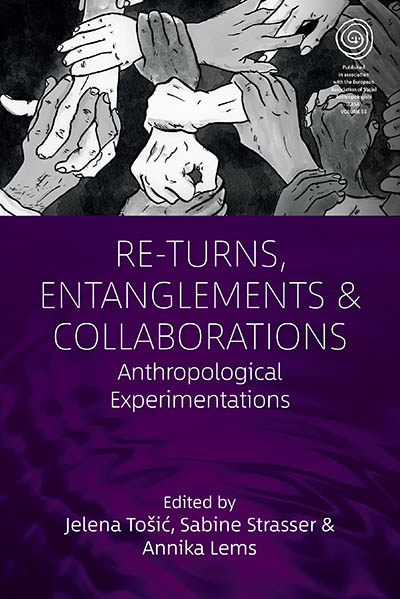
It is organized around eight key themes and concepts that have marked anthropological debates in Europe over the past 20 years. Featuring engaging contributions, anthropologists from different generations and backgrounds come together to collaboratively reflect on questions that keep recurring throughout the book series. As a tribute to anthropology in and of Europe, the book is an experiment in collaboration as much as a testament to anthropology’s vitality and relevance in a world which sees itself confronted by challenges of planetary dimension.
I was honoured to have been invited by the editor to act as ‘chapter editor’ of a reflection on the transformations of ethnography in the recent decades, tasked with selecting collaborators to accompany me in this reflection. Following an editorial suggestion, these were to be ethnographers at different stages of their careers, experimenting with and exploring the mediaof ethnography and a wide range of problems. At the editors’ request, these were t be relevant colleagues different from my regular cothinkers or coinstigators. Also, it required finding the appropriate way of discussing these matters without the grounds of existing knowledge or interactions, and without a suitable opportunity to meet in person to do this. To respond to this challenge, I conceived my role less as an editor and more as a ‘host’: the facilitator of a collaborative process, creating the conditions for the conversation to be fruitful in a rather open-ended way
I had the immense luck of counting on the following guests for our conversations ‘in the kitchen’ of more than textual ethnography:
Maka Suárez, part of the Kaleidos collective (Universidad de Cuenca, Ecuador), who collaborated in the construction of the digital ethnographic platform (EthnoData) designed by Jorge Núñez to pursue research and public engagement work on data practices in and around different forms of violence in Ecuador.
Claudio Sopranzetti, coauthor of The King of Bangkok, a collaborative ethno- graphic novel with editor and translator Chiara Natalucci and illustrator Sara Fabbri based on fieldwork on political movements in Thailand.
Indrawan Prabaharyaka, a member of Labtek Apung (Floating Tech-Lab), a collective whose members are a chemist, an engineer, a visual artist, an architect, and an anthropologist. We work on urban ecology We have done several projects on river pollution, we are currently experimenting with architectural- cinematographic techniques to immerse in and engage with the world of nonhuman primates in Muaragembong, mangrove patches at the periphery of Jakarta.
Marina Peterson, who besides her interest in airport noise as amplifying the indefinite urbanism of Los Angeles has been exploring how experimental forms of writing and sound recording can probe into difficult-to-grasp atmospheric phenomena. She is codirector of the Bureau for Experimental Ethnography at UT Austin, which organizes events and through a series of online meetings: recorded, later transcribed. A selection of these conversations formed the basis of the chapter, subject to a few rounds of rewritting.
***
Our conversations took place online: recorded, then transcribed. A selection of them formed the backbone of the first manuscript of the chapter, later reworked several times. In sharing fragments of our choral and virtual kitchen- like exchanges, we aim to further the book’s concern with collaborations and engagements, discussing the ‘more- than- textual’ transformations of ethnography. As we see it, this entails: (i) learning to appreciate collaborative experiments, projects and engagements – hence, opening up to the multivocality of the places we do research in, the plurality of ways of thinking, doing, telling and conceptualizing already present in the lives of our epistemic partners, from which we could re- learn and re- imagine our practice; and (ii) discussing the challenges of doing multimodal ethnographic projects today – the hopes and wishes, but also the problems or the predicaments encountered when exploring ethnography’s different means and modes of storytelling and doing abstraction. All in all, this was a very enjoyable process. We hope the result is also interesting for you, reader!
Ethnographies: In the kitchen of ‘more than textual’ ethnography
Throughout the last century, ethnography has come to stand as anthropology’s main empirical approach. Over this period, ethnography has developed into a particular mode of enquiry, partaking in and learning from the worlds and lives of people and other beings. This chapter aims to explore the challenges and possibilities of ‘more- than- textual’ approaches, paying particular attention to our own collaborative experiments as well as those of others who inspired us or with whom we have been in conversation. In reflecting about their challenges, we aim to foreground the ‘adventure of relevance’ that contemporary explorations in jointly crafting
research objects and conditions of contemporary anthropological enquiry might entail. We will discuss how contemporary ethnographic works have not simply expanded beyond the graphic but have affected our approaches and our objects of study, also refiguring how and what we take the object of anthropology to be, well beyond ethnos. Indeed, going beyond functionalist, structuralist or cultural–interpretivist approaches, some colleagues have started foregrounding multi- species or more- than- human or environmental concerns, engaging with hard-to-grasp atmospheric phenomena. What we find so intriguing about these experimental openings of the ‘more- than- textual’ is that they force us to consider the following questions: What is ethnography today? And, even more importantly, what could it become?
How to quote: Criado, T.S., Peterson, M., Prabaharyaka, I., Sopranzetti, C. & Suárez, M. (2025). Ethnographies: In the kitchen of ‘more than textual’ ethnography. In J. Tošić, S. Strasser & A. Lems (Eds.) Re-turns, Entanglements and Collaborations: Anthropological Experimentations (pp. 281-309). New York: Berghahn | PDF
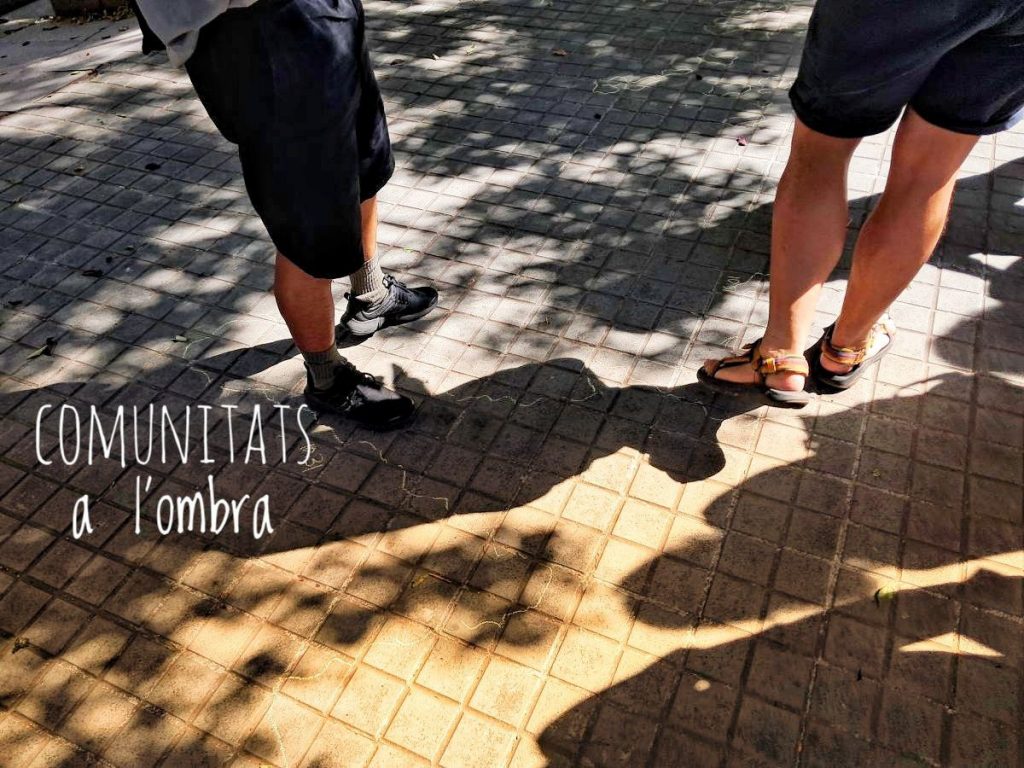
Aquest estiu al Departament d’Umbrologia estem duent a terme el projecte Comunitats a l’ombra (subvencionat per l’Ajuntament de Barcelona): un mapatge participatiu i un procés d’intervenció per tal de construir “comunitats a l’ombra” en el districte de Sant Andreu de Barcelona, liderat per Nusos Coop i Arquitectura de Contacte.
Institut Escola Vapor i Molí (C. de Guardiola i Feliu, 7-9, 08030 Barcelona) dt. 13 maig · 09:15 – 11:45, dt. 20 maig · 09:15 – 11:45, dt. 03 jun · 09:15 – 11:45
Tallers d’anàlisi i cocreació per empoderar els joves com a agents actius en el procés de transformació ecosocial de la ciutat que habiten.
Arran d’una necessitat ja expressada pel veïnat del barri de Sant Andreu de fer-lo més habitable —especialment durant l’estiu—, es proposa aquest projecte que incorpora els joves que habiten aquest espai de forma quotidiana (l’alumnat de l’Institut Escola Vapor i Molí) en el procés d’identificació d’aquesta necessitat i en el desenvolupament de possibles solucions.
Es duran a terme tres tallers amb l’alumnat de 4t d’ESO, seguint l’esquema següent:
Anàlisi d’usos. El focus no se centra tant en la lectura formal de la ciutat com en tot allò que hi passa en l’àmbit de la vida quotidiana. En aquesta sessió es comptarà amb l’acompanyament d’Umbrology, un col·lectiu d’antropòlogues i geògrafes que orienten l’anàlisi urbana a partir de l’ombra i els canvis socials que aquesta comporta.
Mapatge d’habitabilitat. L’objectiu d’aquesta sessió és entendre i fer visibles els factors que fan que alguns espais observats en la sessió anterior presentin una intensitat d’ús més gran i diversa. Aquesta activitat es realitzarà amb el suport de la cooperativa de ciència ciutadana Nusos, i inclourà la presa de dades com temperatura, humitat, etc.
Construcció col·lectiva d’estratègies. A partir de les conclusions extretes en les sessions anteriors, es dinamitzarà una sessió de cocreació per desenvolupar propostes de millora que reforcin la demanda d’ombres plantejada per la comunitat.
Caminar és una manera interactiva d’explorar i entendre una ciutat. A Barcelona, reconeguda com una de les ciutats més caminables, caminar és una activitat agradable. No obstant això, amb l’augment de la calor, caminar en els mesos estiuencs pot convertir-se en una activitat poc saludable i, fins i tot, perillosa.
Aquest taller convida a persones i entitats interessades pel canvi climàtic a les nostres ciutats, així com a recercaires i estudiants de les cièncias socials, les ciències ambientals, les arts i les disciplines del disseny urbà a pensar des de les seves experiències urbanes amb la calor i el sol: identificant espais de perill o exposició i ideant pràctiques col·lectives de protecció i cura.
Ho farem mitjançant dues activitats: primerament, passejarem al voltant de Can Jaumandreu observant, mesurant i cartografiant zones d’ombra (casuals o intencionals), imaginant-les en diferents estacions de l’any amb l’ajuda d’una app.
Després, traduirem aquestes experiències en un taller de co-creació per grups d’una senyalètica urbana del canvi climàtic, on abordarem diferents propostes, variant (1) els materials utilitzats, (2) els modes d’implementació, i (3) el públic objectiu. Creiem que la senyalètica pot esdevenir una pràctica col·lectiva rellevant per prendre consciència i intervenir els nostres espais públics en un context de canvi climàtic que posa en risc a molts diferents col·lectius i persones.
Tancarem amb un testeig i debat a l’exterior sobre les diferents propostes.
L’activitat està dissenyada per a un grup d’unes 20-30 persones participants.
Amb la participació de: Xavier Acarín, Barbara Adams (New School), Zeynep Akıncı, Adrià Bardagí (Arquitectura de Contacte), Marta Belev, Glòria Carrasco Turigas (IS Global), Sandra Carrizo (Asociación Española Contra el Cáncer-Barcelona), Maria Cifre (CareNet, UOC), Raquel Colacios Parra (TURBA, UOC), Tomás Criado (CareNet, UOC), Dennis Dizon, Ada Duran Berrojo, Marina Duran Lombardía (CareNet, UOC), Carme Garcia (Nusos Coop), Benjamin Gauchia (Oficina de Canvi Climàtic i Sostenibilitat, AjBCN), Andrea Nóblega Carriquiry (TURBA, UOC), Laura Oliveras (Agència de Salut Pública de Barcelona), Marina Pera (TURBA, UOC), Irene Ripoll Murcia, Sergio Ruiz Cayuela (IMPACTE, UAB) Isabel Ruiz Mallén (TURBA, UOC)
Editorial note: Prototypes for a Department of Umbrology is the third issue in a series of urban explorations that are part of an ongoing collaboration between Tarde and xcol.org.
How could we transition from a dangerous modernist ‘solar urbanism’ [1] to the renewed hope in the urban powers of shade? This transformation is far from just material or technical one; it also requires culturally symbolic and everyday practical undertakings. However, to achieve this, perhaps there is no other way around experimenting with speculative political practices and collective formations, where ethnography might still play a relevant role: not just as a documentary practice but an interventive one. A possible avenue to try out new forms of ethnographic relevance could be to draw inspiration from artistic practices searching to probe new ways into the contemporary climatic mutation in its complex local expressions.
As suggested in Tarde’s number 6, The City of Shades – the first in a trilogy on urban shades – we could follow the trail of the guided walks proposed by Los Angeles Urban Rangers or the immersive protocols of experimental politics of the Crisis Cabinet of Political Fictions[2]. Their works could be of great relevance to go beyond an attempt at undermining the practices of existing institutions. In fact, at a time when reclaiming the social state as a crucial infrastructure accompanying and sustaining experimentation with the forms of personal and collective protection might be needed, the task might be more akin to what legal activist Radha D’Souza and artist Jonas Staal stated when proposing their Court for Intergenerational Climate Crimes (CICC):
“For art to have emancipatory significance, it must go beyond mere questioning and deconstruction, and learn to retool statecraft’s arsenal to construct alternative popular institutions” [3].
Poster of The City of Shades workshop
Taking this thread, perhaps what is needed in times of a deep climatic mutation and growing extreme urban heat is to propose an alternative popular institution of that kind, as a parasitic companion to the work of existing civic actors and administrations. As put forward in Tarde’s issue #6 we could unfold a Department of Umbrology (DoU) in our urban territories: a space where to equip a new kind of professional of this strange discipline imagined by writer Tim Horvath, as well as a crossroads of knowledges and practices, bundling together those interested in the inquiry on and politics of urban shades.
But what would be the relevant knowledges and the concrete practices that this department, however fictional or speculative, might need to foster? First of all, it would need to gather people devoted to understanding things like: the social and material complexity of shades, the multiplicity of actors and assemblages constituting them; the practices of generating shade, by and for whom; or the forms of sociality that they allow as regions or territories of care, attending to their temporalities, their rhythms, and their spatial dramaturgies. Come what may, its first mandate would be to create the conditions for all this to happen.
Even if we imagined it to be a flexible collective of sorts – perhaps even summoned anew for every issue, articulated around yet-to-be-defined requests or mandates, and devoted to exploring the wide gamut of mediational possibilities ranging from civic or artivist protest to para-institutional endeavors – to grant it some reality we needed a setting, as well as a series of practicable ways for people to imagine this. Our current issue seeks to document a first attempt at doing this.
Testing the DoU hypothesis in a sheltered environment, I: Background
The concrete setting to materialize this speculative scenario took us around six months of on-and-off preparatory work. It happened in and around an open 5-day workshop, The City of Shades, in Barcelona on June 17-21, 2024 [4]. Organized in collaboration with Santiago Orrego, the workshop was backed by my own Ramón y Cajal research funds and a small amount of funding and promotion for the Architectural Weeks of Barcelona. The workshop was put together in collaboration with the City of Barcelona’s Climate Change and Sustainability Office and BIT Habitat, a foundation from the municipality whose mandate concerns deploying internal innovation mechanisms within the city hall and fostering the city’s innovative ecosystem to face municipal challenges.
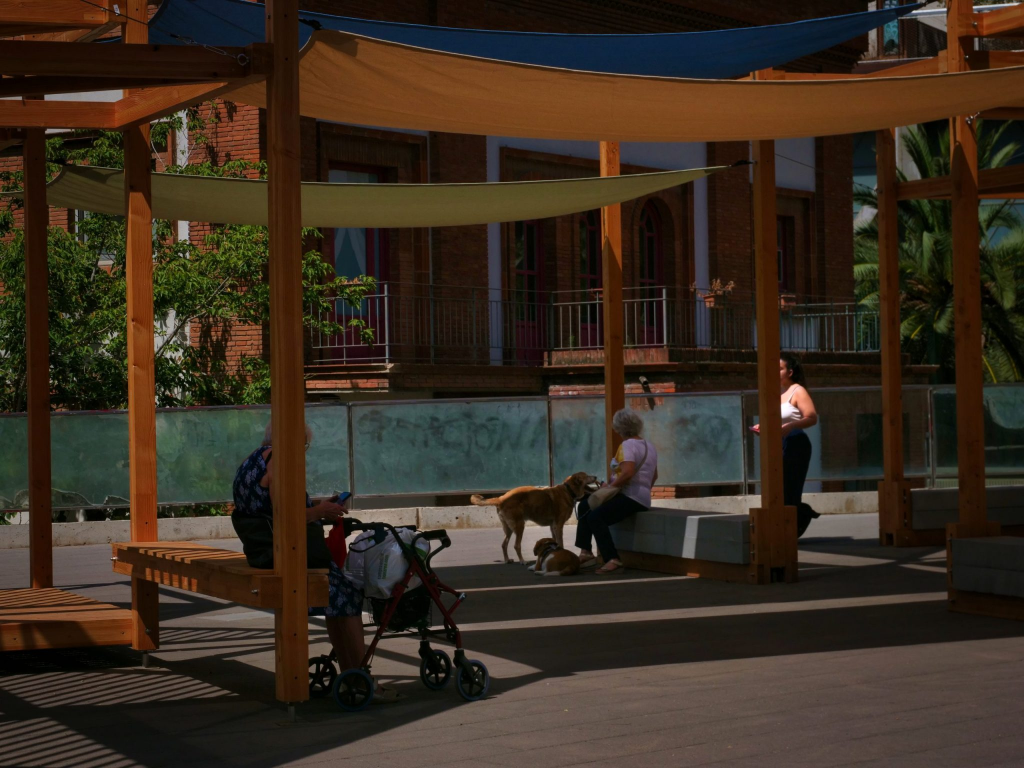
I have been formally collaborating with both areas of the city council of Barcelona since July 2023, when they launched an architectural contest to prototype temporary public space shade solutions for the hot season. The contest wished to make emerging solutions unavailable in the market, responding to a main need detected by the municipality’s public officers: although, in their view, tree shade should be the main way to go, even in the midst of the worst drought of a century, certain urban configurations and regulations make it impossible to plant trees or other forms of greenery. Particularly (1) big open places with underground heavy infrastructure, such as transportation pathways or car parks, (2) small streets where fire regulations would not allow tree planting, and (3) playgrounds due to safety regulations concerning their pavements and zonification. The focus on these three spatial problems, as well as a desire to have re-usable, scalable and modular solutions, became the main prerequisites of the contest.
Heat measurements of uncovered urban soils
The ‘temporary public space shade’ challenge serves to develop one aspect of the ‘shade plan’ conceived in the City Council’s Climate Plan 2018-2030, an ambitious series of adaptation and mitigation interventions, amongst them a wide portfolio of measures to tackle urban heat [5]: ranging from public space interventions (climate shelters, shade infrastructures, bioclimatic itineraries) to attempts at decarbonising building cooling, incentivising aerothermal solutions centring energy poverty. All of this is part of a crucial agenda of the municipality for environmental justice, foregrounding its concern for ‘vulnerable populations’, like children, older and disabled people. Indeed, after increasingly scorching years, with every summer bringing sky-rocketing temperatures, Barcelona’s humid heat is one of the city’s main public concerns.
For the challenge, three consortia were selected by a committee of technical experts who valued how well the initial ideas might develop over a year into good-enough technical projects to respond to the contest’s challenges [6]. The consortia are of a rather mixed nature, comprising companies and architectural studios, cooperatives of architects and woodsmiths, or agricultural greenhouse providers, and a network of cooperative architects and social cooperatives. They were awarded 100 000€ to produce an idea that would be implemented with the advice of the relevant urban planning areas of the municipality, installed in given public spaces, and monitored in the next hot season. The incentive for this prototyping endeavor is that later, they could define the municipality’s calls for tenders for future urban shade products and establish a business model selling them to the public sector.
Render of one of the prototypes, as discussed on site in The City of Shades workshop
Since July 2023 I have joined as a peculiar fly-on-the-wall ethnographer the technical mentoring meetings, where the projects’ makers met with different public officers from relevant municipal areas – usually, engineers and architects by training – in charge of monitoring any new addition to Barcelona’s already packed public space. Interestingly, as the installation phase approached, I was asked for advice.
Although our formal collaboration agreement doesn’t include any payment for services, all parties became interested in having my views on how to approach the ‘social monitoring’ of the projects, a requirement from the municipality. It accompanies a more technically-developed ‘climatic monitoring’ (measuring temperature, humidity, shade coverage, etc.). Each project will need to study their own prototype and produce accounts of societal acceptance and use, as well as of thermal comfort [7]. Ever since, I have been informally suggesting and advising how to engage in the design of their surveys (sampling, data-gathering techniques, etc.) or discussing more or less experimental cartographic approaches to study spatial use: flow movements and permanence.
Render of one of the prototypes, as discussed on site in The City of Shades workshop
Even if thinking on the relations between shades, architecture, and heat practices has proven an extremely creative conceptual exploration from the onset, my ethnographic work remained confidential and tied to an activity of minute-taking: filling up pages and pages of a notepad to remember rather dense technical details. This is where the idea of a collective and public-oriented Department of Umbrology, where to inquire and discuss intuitions on the urban life of shade with others, became an interesting hypothesis to explore and experiment with forms of ethnographic relevance in the vicinity of all the other technical actors I have been collaborating with: not treating ‘the social’ as a closed category in advance (what the material or the climatic is not, the human factor), nor invoking it after the fact (providing sanctioning takes about technology acceptance) but rather evoking its emergent, everyday and ongoing creative process. To do this, we needed to imagine ways in which ethnography could come to matter: hopefully opening up what the social might mean in different shady locations, enabling more nuanced takes on the complex social and material life of shades and their forms of urban care.
Graphic storytelling of the inaugural presentation of The City of Shades workshop by Carla Boserman
i. Testing the DoU hypothesis in a sheltered environment, II: Producing a collaborative workshop
Testing ‘what a DoU might be’ was the inspiring idea behind The City of Shades workshop. A 5-day event, open to like-minded interdisciplinary people coming from the arts and humanities, the social sciences, and the design and architectural disciplines, with mandatory prior registration to screen who was interested and be able to create relevant synergies when attempting to articulate an exploratory collective research space like this. Sensing the organizational burden would be too much for us to carry the conceptual weight of the workshop, and in a spirit of collective speculation where many more views are needed, we additionally invited as mentors six colleagues from the arts and the social sciences working on experimental ethnographic approaches and with an artistic sensitivity to inquiry, who would push us to take it seriously or contribute to expand it beyond what we had imagined.
Cap with the DoU corporate logo
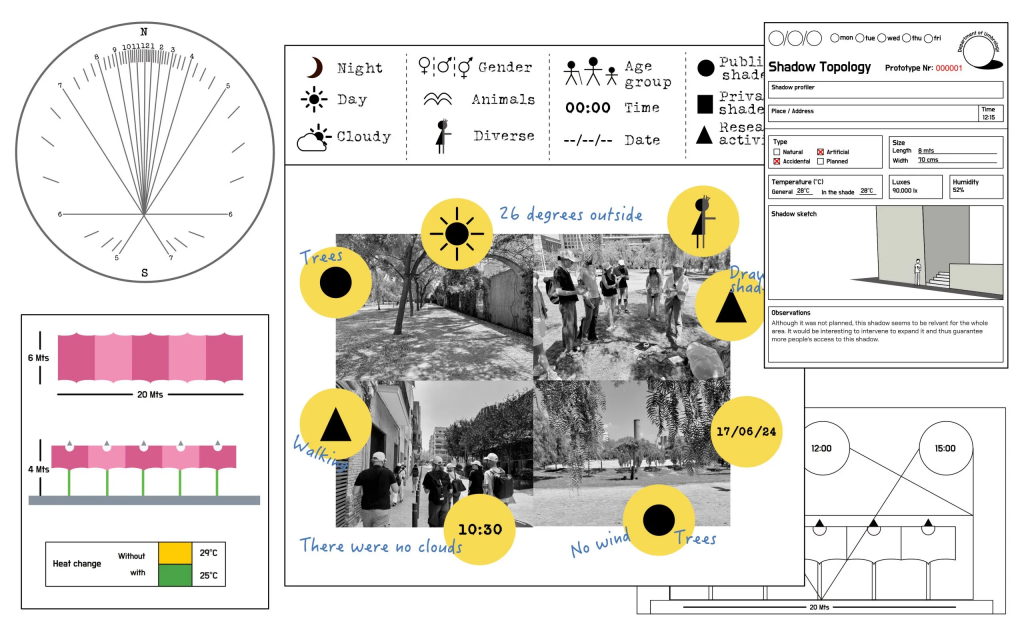
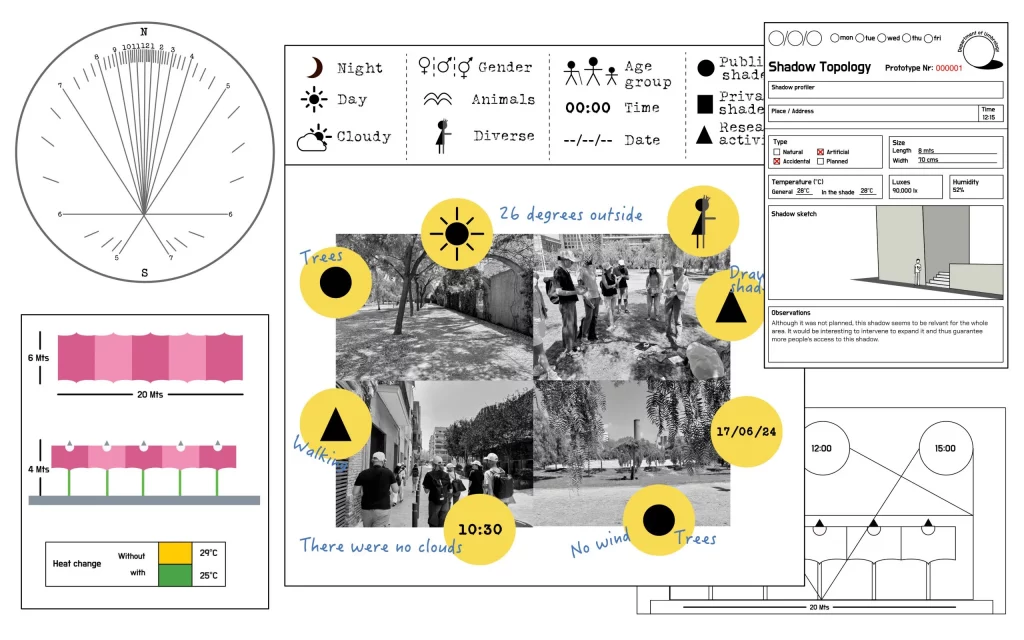
To render this practicable, we imagined umbrologists would require a series of roles, such as: (1) Shadow topologist, (2) Shade research-creator, (3) Sunlight cartographer, and (4) Community Shade Resilience Analyst. For each of these roles, we provided a small description and designed a series of specific forms, enabling the DoU to be imagined as a department of sorts: working ‘in the shadows’ of real ones, re-signifying what ‘shadowing’ tends to mean in common ethnographic parlance [8]. We also created a logo, a website, and baseball caps each of the participants could wear to protect from the scorching sun in our urban explorations as a way to enforce an idea of corporate identity and to become noticeable when moving around. The materials gathered in Tarde’s issue 6 and its zine were the main outcome of this preparatory effort. Indeed, the long essay was the discursive opening of the workshop, and the zine contained some of the forms we conceived and tried out.
We didn’t imagine this kit to be more than a first workable version, something enabling us to plunge into the problem and its conundrums more quickly, helping people have something to work with when thinking on shades for the first time. Our aim, thus, was to put to a test these bureaucratic forms undertaking a series of guided walks (around the Poblenou district of Barcelona, where the workshop venue was located; and monographic visits to the future sites where the municipal shade prototypes were going to be implemented, meeting the projects). We wanted to do so with the objective of later engaging in the hands-on redesign of the roles and forms of what a DoU could be, inspired by lectures, presentations and hands-on activities.
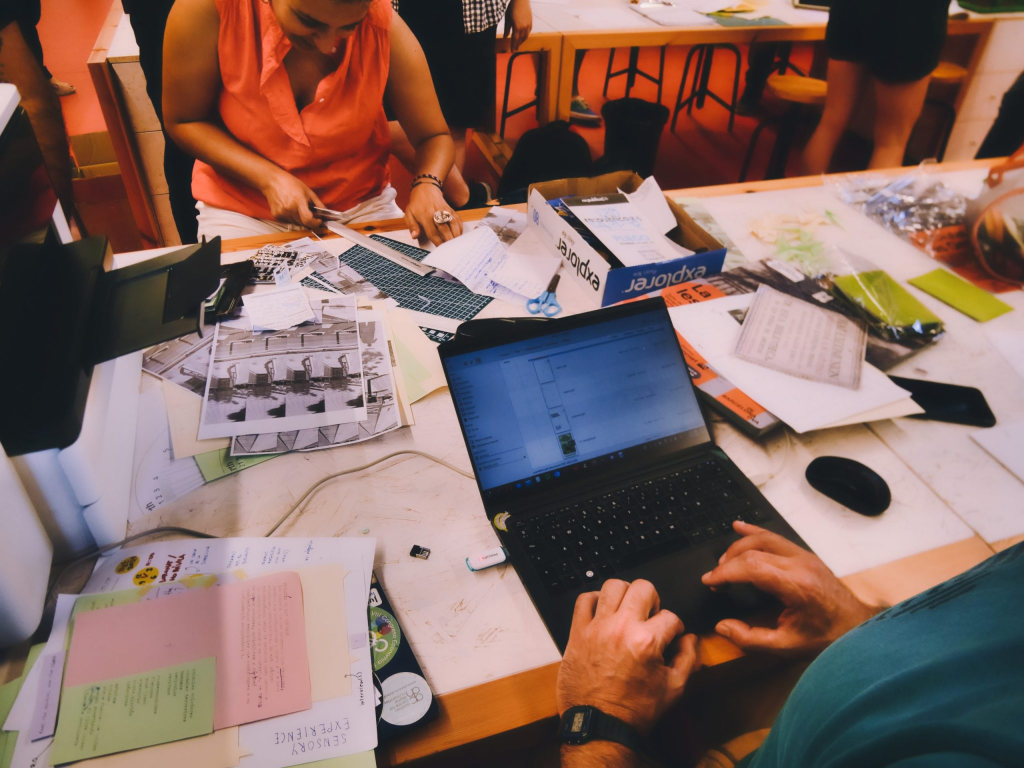
With the help of the mentors and a core group of 15 people who had registered – mostly from social sciences and architectural backgrounds – and the fluctuating assistance of people from the architectural contest, we had the immense luck to explore the possible research devices and mandates for the DoU. Our learnings were summarised on-site: the workshop ended with the production in less than 8 hoursof a fanzine, with the help of the open source collective PliegOS (our thanks again to Enric Senabre and Ricard Espelt for their work on this!), specialized in alternative forms of public documentation of events [9]. This raw and wonderful collective zine formed the backbone of the ethnographic kit for the study of urban shades you can now download in this issue. The only upgrade has been slightly polishing the language and developing aesthetic continuity between the different parts.
Collective work on a quick zine in The City of Shades workshop
ii. Learning to become umbrologists under the scorching sun: Documenting the workshop
Sweating over our cards, on different walks we learned to think about the urban inclinations of the sun, to relate to trees and plant coverage, to draw shadows with solarized spinach paper, to distinguish shade’s private contours (in the form of bars and terraces) from shady public infrastructures, to understand the relevance of broadening our view beyond the human (exploring an ethology of shades!), and to find ways to gather experiences of urban shades.
Our workshop took place mostly in the Sant Martí district of Barcelona, where the Poblenou neighbourhood is located. This is where I live and work, and my previous experience walking around with my daughters informed the selection of the places. But we also ventured beyond it when visiting the places where the municipality’s shade prototypes were to be emplaced and installed. This experimental journey also took us to the seafront of Barceloneta, then to the immense gap between large buildings of the Maresme-Forum over one of Barcelona’s main ring roads, or to the highline of the Sants district, created over the transportation box that the underground and commuter trains use to traverse the city.
As novice umbrologists, these endeavors enabled us to probe into the true power of urban shades, which also swallowed a measuring briefcase from the municipality without leaving a trace in one of our visits. In the final session, prior to working on the closing zine, I attempted to summarise our learnings as follows.
First lesson. To work as an umbrologist, it is advisable not to lose sight of one’s own body, as well as pay attention to the corporeality of our recording materials. Climates are mutating, and so should our recording devices! We learned this together with artist Carla Boserman, who pushed us to try out the complex task of following moving shades with blank pieces of paper, forcing us to go beyond reifying and representational takes. Carla also introduced us to the art of drawing through the climate-prone technique she has been recently exploring: anthotypeson emulsified papers, the predecessor of photographic printing, using the sun as a recording device.
Catching shades on paperA kit to work on anthotypes
Following shades and their shaky silhouettes, we realized that shades are anything but static. They move, and they move us with them. Also, they are not a single thing but a strange singular amalgamation of contours in between opacity and luminosity. As Carla told us, she became passionate about anthotypes when inquiring on affective forms of inscription that might also be attentive to atmospheric changes [10]: that is, not thought of from pens or pencils that always work, irrespective of the weather they are used in, but from the unstable environmental relationship of the sun imprinting its radiating force on fragile papers.
Shade on white notebook
Second lesson. On our walk through Poblenou, largely inspired by Carla’s work, we realised that it did not make much sense to think of shades as atmospheric occurrences, even though there are many useless, ephemeral or evanescent shadows. Rather, as we discussed at length that same Monday morning, the urban shades that interest us, those that allow us to shelter and cool off, should be thought of more as existential or lived regions.
Umbrologist at work
This was the main result of a collective conversation after spending some time, amazed as well as surprised, debating at length about an intersection. In it, shades were in some way ‘privatized’ by a terrace for the greater part of the day, leaving the nearby playground untouched, turned into an accidental grill for risk-prone parents and children. This ‘regional gaze’ at shades, as someone aptly called it in our discussion, also meant understanding them not from their metric spatial dimensions or climatological indicators but as interwoven topologies of atmospheric care for a plurality of bodies: territories plotted by power relations, flows of movement and knowledge, and divisions enacting sometimes profoundly unequal conditions of access, or as locales of possible multispecies inhabiting [11].
Playground under the sun
Visiting the locations of the municipality’s shade prototypes, we realized that, in addition to thinking about their patterns or modularity, we always needed to pay attention to: their surroundings, the habitual and possible uses of space, and the modes of circulation, the symbolism and the affordances of given places; and to actors both human and other than human (doves, seagulls, dogs and parakeets being regular companions in our walks). That is, to the different ways in which different actors make these spaces existential territories of life, both in the open and in hideouts, in different moments of the day as well as in the dark hours of the night. This regional, domain-specific look, attentive to the places and their shady life, felt to us of the utmost importance given that the prototypes could redefine and alter urban care: both opening up conflicts that didn’t exist before, hardening others that were hidden, as well as enabling newer ones to emerge.
Parakeet sheltered from the sun
Third lesson. This corporal approach and the importance of a regional perspective had as a result a full revamping of the kit we had proposed, developing new sheets and protocols of analysis of and intervention in the shades. Also, thanks to the fabulous interventions of Isaac Marrero-Guillamón [12] and Fernando Domínguez Rubio [13], we started imagining different mediational mandates for what a DoU might wish to respond to, drawing from the work of different artistic and activist forms of research they suggested us to resonate with.
As a result of all of these intense 5 days, the zine we worked on materialized a handful of activities to activate a possible DoU, enabling a bunch of research modalities that could be mobilized in different contexts of use.
Reworking our previous kit
iii. Prototypes for a DoU: Imagining a future practice
All in all, what these learnings prompted us to reflect on is the poetic and political potential of shades, which transcends the idea of simple technical solutions to thorny problems. In our workshop, shades appeared as a popular and well-spread figure of everyday climatisation (who can’t create shades, even with their own hands?), whose mundanity might precisely allow re-politicizing climate and weather not as things out there, observed and pinned down by meteorologists or climatologists, but as an urban collective concern, eliciting a broader conversation on how we could learn to live in more protective urban ecologies.
In other words, urban shades could also have the power to renew political ecology, the practice of creating and inhabiting them, unfolding a desire for exploration, play, and doing things with others that might not be so obvious when thinking of conventional forms of climatization grounded on air conditioning or ventilation [14]. Precisely because of its mundane nature, shading – a manual activity [15], a hands-on practice of learning to collectively condition and make a space inhabitable under the sun [16] –subtly but unavoidably challenges the problem of modernist solar urbanism and helps qualify mechanical air conditioning acting as a technology for forgetting the deadly fossil fuel substrate of our ways of living and its role in the formation of our atmospheric conundrums [17].
As a result, this issue of Tarde offers prototypes for a Department of Umbrology: a more grounded tentative proposal, slightly upgrading what we learned in the workshop. The accompanying zine, hence, is a small kit with a series of practical exercises and research devices: on the one hand, there are devices enabling a sensitization to what thinking with shades does to understanding the urban, as a matter of sun inclinations and exposure, or a first attempt at their inventory, documenting their changing features, their uses, and uselessness; on the other hand, we have devices for a more collective analysis of shades as regions with their spatial divisions, a proto-ethology of their human and other than human actors, and a series of prompts to elicit individual and group experiences.
The shade as an intergenerational and multispecies region?
Taken as a whole, these six devices enable us to imagine a future practice for the DoU to continue existing. This might also mean mutating in each place and around particular places and topics [18], for the DoU should not just be a collaborative space to study the urban life of shades but an urban space to enter into generative and fruitful shady relations! [19]
References
[1] With this expression, rather than discussing the use of solar power in urban settings, I refer to the signature modernist hygienist drive to design urban settings for clean air circulation and insolation, as a heliocentric approach to city-making. For more context, see Tarde’s issue #6: https://tarde.info/the-city-of-shades/
[2] The latter define their work as “an exercise in political speculation that different experts make to bring possible futures to the present through fictional scenarios that must be addressed within a limited period of time.”
[3] D’Souza, R., & Staal, J. (Eds.). (2024: 10). CICC – Court for Intergenerational Climate Crimes. Rotterdam: Framer Framed.
[11] Something for which I’ve found both Vinciane Despret and Bruno Latour’s territorial musings of great food for thought. See Despret, V. (2021). Living as a Bird. Wiley; Latour, B. (2021). After Lockdown: A Metamorphosis. Polity. For an interesting companion for this kind of territorial thinking, see Aït-Touati, F., Arènes, A., & Grégoire, A. (2022). Terra Forma: A Book of Speculative Maps. MIT Press.
[12] Isaac took us on a tour de force revisiting the inspiring works of a dozen artists exploring modes of representation and collaboration to render practicable different ‘mediational’ possibilities of what the DoU might be or, in his words, “I would wish that a Department of Umbrology could think in recursive cycles of research, relationship, and public interfacing”. To name but a few of the many examples he discussed at length to substantiate this, allow me to select just three, because of the impact they left on some of our conversations: Silvia Zayas’s magnificent collaborative artistic speculation ruido ê, working – by means of a documentary and other media – with oceanographers to expand their sensory registers of subaquatic perception when studying manta rays and sharks; Stephen Gill’s Buried photographic series, a work of photographic remediation of the future transformation of the contaminated soil of the Olympic site in London (a moment where many informal uses of the space were lost) recording scenes of the life of these ‘post-industrial marshes’ with a cheap camera, then burying them images on the ground of the conflict, letting them impact it, thus being a double record of the chemicals in the camera and on the ground; Jessie Brennan’s The Cut, a juxtaposed drawing exploring fragments of the oral history of a neighbourhood from London traversed by a canal, using the canal as the storytelling device.
[13] Fernando discussed the speculative work around fiction that the Crisis Cabinet of Political Fictions and cognate works have sought to render practicable. Discussing at length the relevance of fiction to mould reality, he expounded the different scenarios they had been working on. In his presentation, he advocated for a use of fiction that discloses its own shadows (absences, problems, strange effects), rather than hiding its own productive and speculative engine.
[14] With the wonderful exception of the very inspiring hands-on artistic take to ‘air conditioning’ explored years ago by Iñaki Álvarez and Carme Torrent, inventing a wide variety of exercises whereby the air we breathe and sweat is rendered collectively articulate in given situations by means of “actions and choreographic and climatic situations in which the air can be the main character and a performer”, see https://mercatflors.cat/en/espectacle/salmon-air-condition-2/ (the materials of these sessions, graciously donated by Blanca Callén were of great food for thought when imagining the workshop; my appreciation goes to Iñaki, Carme and Blanca for the long conversation we had on this experience).
[15] For a very graphic exploration of this, see Fernández, M. (2021). Tejiendo la calle. Rua ediciones. This book recounts the story of a community-driven architectural project in the village of Valverde de la Vera (Spain), where villagers have engaged in a process of creating parasols out of recycled plastic, later on deciding collectively where and how to hang them in the hot season. This project beautifully shows how these parasols are not just ways of sheltering from the sun, but the changing fabric of a shady community in the making.
[16] In that sense, shading practices could very well be thought of as the next of kin the embodied approaches to ‘weathering’ proposed by Neimanis, A., & Walker, R. L. (2014). Weathering: Climate Change and the “Thick Time” of Transcorporeality. Hypatia, 29(3), 558-575.
[17] An argument developed at length by Barak, O. (2024). Heat, a History: Lessons from the Middle East for a Warming Planet. University of California Press.
[18] In his intervention, Adolfo Estalella ventured beyond his work on ‘ethnographic invention’ (c.f. Criado, T. S., & Estalella, A. (Eds.) (2023). An Ethnographic Inventory: Field Devices for Anthropological Inquiry. Routledge) to offer ‘diffraction’, an optical concept taken from the work Donna Haraway, as an interesting new way to discuss the different attempts, trials and tribulations of a ‘shady’ ethnographic practice beyond the totalising idea of ‘method.’
[19] What Francisco Martínez referred to, in another of the presentations of the workshop, as a practice of opacity. See Martínez, F. (2024). “Lights out: practicing opacity in Estonian basements.” Etnográfica, 28 (1), 285-297.
Las Becas Leonardo de la Fundación BBVA están destinadas a apoyar el trabajo de investigadores y creadores culturales que, encontrándose en estadios intermedios de su carrera, se caractericen por una trayectoria científica, tecnológica o cultural altamente innovadora.
Al dotar a estas becas con el nombre propio de Leonardo da Vinci se quiere enfatizar los atributos característicos de esa figura universal de la cultura, destacadamente la pasión por el conocimiento, la apertura y exploración de nuevos campos y problemas, la interacción entre trabajo teórico y observacional o experimental, así como el diálogo y realimentación entre los dominios de las ciencias de la naturaleza y de la vida, la tecnología, las humanidades y las artes.
En correspondencia con su nombre, las «Becas Leonardo» se dirigen a facilitar el desarrollo de proyectos individuales que aborden facetas significativas y novedosas de objetos y cuestiones científicas, tecnológicas y culturales del presente, elegidas libremente por sus autores.
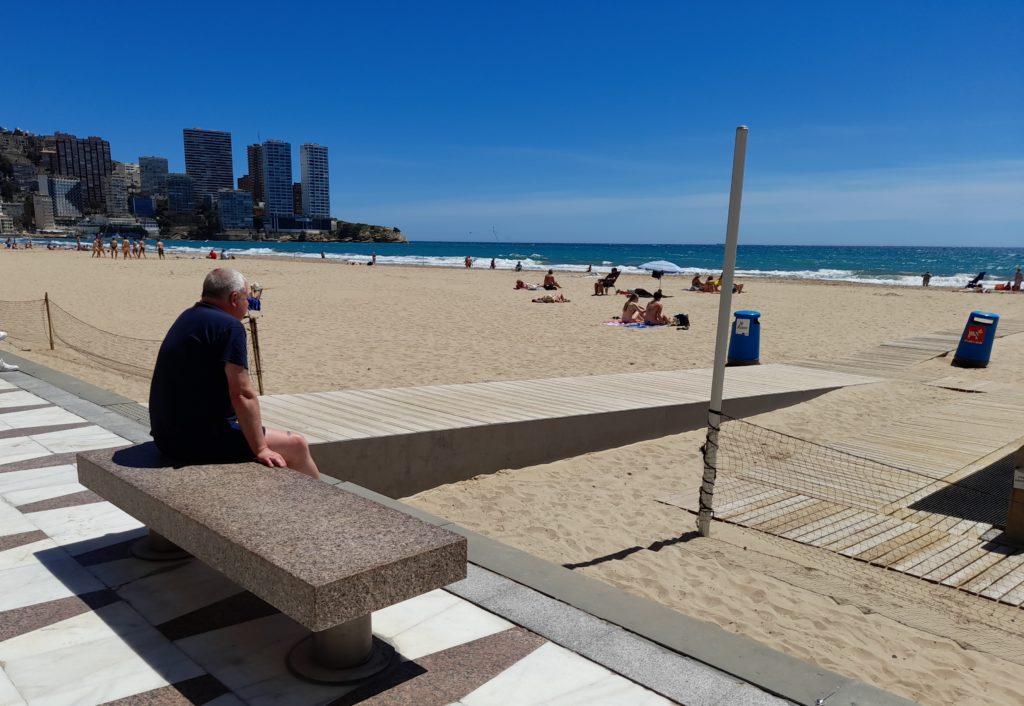
[ES] Ciudades que envejecen: Los futuros del urbanismo de la edad avanzada en el litoral español desea estudiar el litoral mediterráneo español como un laboratorio presente y futuro de distintas versiones de la ‘buena vida’ bajo el sol, en un momento peculiar en el que las crisis demográficas, de vivienda y medioambientales confluyen en una tormenta perfecta. En los últimos cincuenta años, la costa mediterránea española –uno de los mayores enclaves para la ‘migración de retiro’ en el continente europeo– se ha enfocado en el urbanismo de la edad avanzada (‘late life urbanism’) a través de una enorme inversión en infraestructuras urbanas de cuidado y en la transformación de la accesibilidad en viviendas, así como en equipamientos urbanos (transporte público, parques, playas).
En este contexto crítico de formas urbanas de envejecimiento, el proyecto tiene dos objetivos principales: (i) estudiar la genealogía del urbanismo de la edad avanzada (trabajo de campo y de archivo) en uno de los siguientes enclaves: la Costa Blanca (Alicante), la Costa del Sol (Málaga), el Maresme (Barcelona) o Mallorca; y (ii) elicitar la imaginación de futuros para la vida urbana de las ciudades que envejecen dentro de los límites planetarios (a través de talleres especulativos e inmersivos).
El proyecto tiene lugar entre octubre de 2024 y marzo de 2026.
[EN] Ageing Cities: The Futures of Late Life Urbanism on the Spanish coast wishes to study the Spanish Mediterranean coast as a present and future laboratory of versions of the ‘good life’ under the sun, at a peculiar moment when housing, demographic and environmental crises are coalescing into the perfect storm. For more than fifty years, the Spanish Mediterranean coast, one of the main hotspots of ‘retirement migration’ in the continent, has developed a signature approach to late life urbanism: with a great investment in urban infrastructures of care and urban accessibility transforming dwellings, as well as urban equipment, such as public transports, parks and beaches. In this critical context of urban forms of aging the project has two main objectives: (i) studying the genealogy of late life urbanism (undertaking fieldwork and archival research) in one of the following enclaves: Costa Blanca (Alicante), Costa del Sol (Málaga), Maresme (Barcelona) or Mallorca; and (ii) eliciting the imagination around the futures of late life urbanism (by means of immersive speculative workshops) within planetary boundaries.
The project will run from October 2024 to March 2026.
[CAT]Ciutats que envelleixen: Els futurs de l’urbanisme de l’edat avançada al litoral espanyolvol estudiar el litoral mediterrani espanyol com un laboratori present i futur de diferents versions de la ‘bona vida’ sota el sol, en un moment peculiar en què les crisis demogràfiques, habitacionals i mediambientals conflueixen en la tempesta perfecta. En els darrers cinquanta anys, la costa mediterrània espanyola – un dels principals enclavaments per a la ‘migració de retir’ al continent europeu – s’ha enfocat a l’urbanisme de l’edat avançada (‘late life urbanism’) a través d’una enorme inversió en infraestructures urbanes de cura i en la transformació de l’accessibilitat a vivendes, així com en equipaments urbans (transport públic, parcs, platges).
En aquest context crític de formes urbanes d’envelliment, el projecte té dos objectius principals: (i) estudiar la genealogia de l’urbanisme de l’edat avançada (treball de camp i d’arxiu) en un dels enclavaments següents: la Costa Blanca (Alacant) , la Costa del Sol (Màlaga), el Maresme (Barcelona) o Mallorca; i (ii) elicitar la imaginació de futurs per a la vida urbana de les ciutats que envelleixen dins dels límits planetaris (a través de tallers especulatius i immersius).
El projecte tindrà lloc entre l’octubre del 2024 i el març del 2026.
17-22 July 2024 | Hall Hub, Open University of Catalonia (UOC), Rambla del Poblenou 154, 08018 Barcelona
Photo: Interactive workshop at Medialab-Prado in Madrid (Medialab-Prado)
EASA is pleased to announce its first PhD summer school, supporting the development of early career scholars.
This will be held in Barcelona in the week before the 18th EASA Biennial Conference. The focus of the six-day school will be ethnographic experimentation.
Ethnographic experimentation is an anthropological response to the epistemic challenges of our contemporary world. Beyond traditional norms and forms of ethnography, there are all kinds of projects that experiment with forms of representation, fieldwork, and analysis. The ‘experiment’ emerges in all these ethnographies as a distinctive epistemic practice, different from observational activities that are the foundation for its empirical engagements. Experimentation is an opportunity to reconceptualise and transform the empirical practices of anthropology.
This summer school, organised by Adolfo Estalella and Tomás Criado, brings together a programme exploring the analysis, characterisation, and design of ethnographic experiments, along with opportunities to try them in practice. The school combines conceptual sessions with group debates and hands-on practical activities. Field experiments will be designed to respond to a situated ethnographic challenge. The school will foster a convivial atmosphere of mutual learning between participants and an openness to local actors with whom relevant approaches could be discussed and explored. Participants will be equipped with an analytic repertoire as well as a series of practical skills to attempt their own ethnographic experiments.
Funded and promoted by EASA. Organized by xcol. An Ethnographic Inventory Curated by Adolfo Estalella (UCM) and Tomás Criado (UOC)
Partners: Open University of Catalonia (UOC); Social Anthropology and Social Psychology Dept., Complutense University of Madrid (UCM); Anthropology Department, Spanish National Research Council (CSIC); Spanish Association of Social Anthropology (ASAEE)
Who can apply?: PhD students who are paid-up members of EASA. Selection will be based on application fit and diversity criteria.
Registration fee: €150. Dinners during the summer school are included.
Travel Bursary: partial travel bursaries will be available from EASA based on need.
How to apply: applicants are asked to explain how they plan to use, or have used, experimentation in their own PhD research. Apply here.
The application deadline is May 17 with the aim of communicating results by May 31.
**
Pedagogical proposal and methodology
The school combines theoretical sessions, debates and practical activities. Students will work in small groups on two sites/problems.
Theory, case, and debate sessions. These sessions are structured in three slots: a brief theoretical introduction (30 min.), a case that will be presented by a group of students (30 min.), and a debate (30 min.).
Hands-on activities in the field. Students will have to develop an experimental project during the week-long school. Groups will engage in two sites proposed by the school with the goal of making a brief empirical investigation and developing an ethnographic experiment.
Mentoring. Each group will have an assigned tutor who will discuss with them their experimental projects in daily meetings.
Self-managed dinner. The school will pay particular attention to the informal moments of social interaction, in this sense dinners will be a special moment to socialize. Participants will be in charge of organising it.
13.30 – 15.30. Lunch on site (each group on their own).
15.30 – 19.00. Activity in the field: devising devices.
19.00 – 20.00. Group debriefing meetings with tutors.
20.30. Dinner. Cooking together (self-managed).
Saturday, 20 July, 2024
10.00 – 13.30. Hands-on session: field site investigation.
13.30 – 15.30. Lunch on site (each group on their own).
15.30 – 19.00. Hands-on session: working on ethnographic accounts.
19.00 – 20.00. Group debriefing meetings with tutors.
20.30. Dinner. Cooking together (self-managed).Sunday
10.00 – 13.30. Hands-on session: field site investigation.
13.30 – 15.30. Lunch on site (each group on their own).
15.30 – 20.00. Hands-on session: working on ethnographic accounts.
20.30. Dinner. Cooking together (self-managed).
Monday, 21 July, 2024
10.00 – 13.30. Meeting with tutors: Hands-on session at UOC.
13.30 – 15.30. Lunch on site (each group on their own).
16.00 – 19.00. Public presentations of the group experiments.
20.00. Dinner and good-bye party.
Readings
1st session. Ethnographic experimentation: an introduction.
Tomás Sánchez Criado & Adolfo Estalella. 2018. Introduction. Experimental collaborations. In A. Estalella & T. S. Criado (Eds.), Experimental collaborations. Ethnography through fieldwork devices (pp. 1-30). New York, Oxford: Berghahn.
First case
Cantarella, L., Marcus, G. E., & Hegel, C. (2019). Ethnography by design: Scenographic experiments in fieldwork. Taylor & Francis. Introduction and Chapter 3.
2nd session. Ethnography, more than a method: Field devices for anthropological inquiry
Law, J. (2004). After Method: Mess in Social Science Research. Routledge. Introduction.
Law, J., & Ruppert, E. (2013). The Social Life of Methods: Devices. Journal of Cultural Economy, 6(3), 229-240.
Second case
Khandekar, A., Costelloe-Kuehn, B., Poirier, L., Morgan, A., Kenner, A., Fortun, K., & Fortun, M. (2021). Moving Ethnography: Infrastructuring Doubletakes and Switchbacks in Experimental Collaborative Methods. Science & Technology Studies, 34(3), 78-102.
3rd session. The ethnographic invention.
Estalella, A., & Criado, T.S. (2023). Introduction: The ethnographic invention. In T.S. Criado & A. Estalella (Eds.), An Ethnographic Inventory: Field Devices for Anthropological Inquiry (pp. 1-14). Routledge.
Third case.
Hartblay, C. (2020). I Was Never Alone or Oporniki: An Ethnographic Play on Disability. Toronto University Press. Introduction.
4th session. Styles of ethnographic experimentation.
Estalella, A. (n/d). The anthropological experiment (and the disappearing field of ethnography).
Fourth case.
Martínez, F. (2021). Ethnographic experiments with artists, designers and boundary objects: Exhibitions as a research method. UCL Press. Self-selected fragments.
5th session. Beyond text:Experiments on ethnographic expression.
Cox, R., Irving, A., & Wright, C. (Eds.) (2016). Beyond text?: Critical practices and sensory anthropology. Manchester University Press. Introduction.
6th session. Beyond representation: Experiments on multimodal anthropology.
Dattatreyan, E. G., & Marrero-Guillamón, I. (2019). Introduction: Multimodal Anthropology and the Politics of Invention. American Anthropologist, 121(1), 220-228.
Sixth case.
Farías, I., & Criado, T.S. (2023). How to game ethnography. En T. Sánchez Criado & A. Estalella (Eds.), An Ethnographic Inventory: Field Devices for Anthropological Inquiry (pp. 102-111). Routledge.
Anthropogenic atmospheric phenomena (heat, hurricanes, pollutants, wildfires) pose increasing challenges to multispecies inhabitation. How is care re-invented when undoing the patchy effects of environmental violence? We aim to discuss anthropological experiments with ‘ecologies of support’.
Long Abstract
Due to anthropogenic intervention atmospheric phenomena, such as air pollutants, heat, hurricanes, thunderstorms or wildfires are every day more – albeit in some contexts more than others – posing impossible challenges to collective inhabitation, human, and other-than-human. This panel wishes to ask what forms of care and enduring are being repurposed and invented when relating to the many challenges these atmospheric conditions pose, attempting to undo the patchy effects of environmental violence.
In approaches to human and multispecies care in anthropology, environmental humanities and STS, the use of ecological tropes (e.g. landscapes) abounds to describe changing or complex social and material configurations, but what might it mean to re-think care as an atmospheric matter? Talking of ‘ecologies of support’ we wish to account for experimentation with generative and unsettled care responses to atmospheric phenomena that are hard to apprehend, due to their sheer phenomenological ungraspability (because of either their temporal or spatial scales: too fast, too slow, caught in between deep and shallow time, microscopic or gigantic, happening in non-coherent or non-unitary ways), hence requiring a vast array of devices and collective work to articulate or to become sensitized to them.
Beyond conceptual takes, we seek to foster a range of explorations and responses where anthropology could become an atmospheric care practice. Thus, we would also like to welcome approaches to collaborative, public, more-than-textual ethnographic works in a wide variety of guises and atmospheric topics experimenting with setting up ecologies of support in their own right.